From the print edition · Original text and illustrations
4 a.m., some random weeknight in early August 2025. I wake up suddenly to find my twin standing above me. I’m not much into telepathy, tarot cards, astrology, or anything without a firm basis — but I have to admit, there have been many strange moments when my twin and I seem uncannily in sync.
It’s been that way for as long as I can remember. We’ve had countless moments where we sat in silence, only to start singing the same song at the same part, at the same time. This time, he was in need of help, and I woke up without him having to ask, signal, or make a sound. I don’t know what to make of it — some kind of nonverbal perception I seem to have only with him, unlike with anyone else. I can read him without
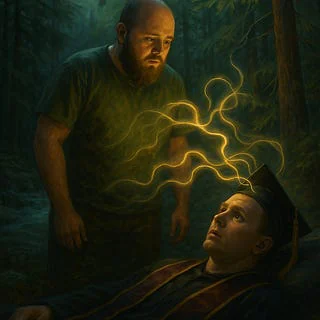
Harry submits to Voldemort in
consciously trying, in ways that don’t apply to my other
the woods to me, personally. Perhaps that’s why I’ve got a
relationships. Just a note I thought worth sharing — and no, it’s
robe on.
not telepathy.
He had again become convinced that he was going to hell and facing imminent death — that God was going to strike him down. He was visibly distressed, and it was clear there was no talking him out of it.
After dropping my twin off at the hospital, I went to a nearby gas station and just sat there at 5 a.m., in tears and heartbroken that this is his reality on a regular basis.
I’ve had to learn that when you’re faced with this kind of irrationality, it’s more helpful to listen and be a calm companion than to try to force rationality onto it. Try to be there with them as best you can, and give them rope to return to shore, hopefully. It’s not a situation where you meet fire with fire.
My twin, now 28, was diagnosed with schizophrenia when we were 26. He was in Iowa. I was in Rhode Island, in the first weeks of graduate school at Brown, trying to adapt to an entirely new environment. Clinically speaking, these are persecutory delusions with religious content — one of schizophrenia’s positive symptoms, meaning the presence of experiences or perceptions that shouldn’t be there, such as hallucinations or delusions.
It was a life-changing diagnosis — one that made it difficult to concentrate on my own life directly in front of me. Selfishly, as his twin, I wondered — am I next? Statistically, odds are about 15% that you’ll develop schizophrenia if your fraternal twin has it — roughly one in seven, depending on the source. That may not sound enormous, until it’s you with those odds. Thankfully, I seem to be alright. In the general population, the lifetime risk is much lower, about 0.3% to 0.7%, again depending on the source.
To be fair, there was a lead-up to his diagnosis. Clinically, this is referred to as the prodromal phase. About six months earlier, he had gone missing while on a trip in Arizona. Three months before the diagnosis, when I was home in Iowa, I ran into him homeless — by choice. I had to beg him to get lunch with me, an emotional experience I lack the words to explain.
And so, after 25 years of always being able to comfort my twin, explain things, and bring him on board when necessary, for the first time in my life I found myself unable to reach the person I know him to be. In sports, school, socially — you name it — I had always been a caretaker of sorts for him, and we were friends, of course.
To watch someone you love be panicked and terrified in ways you cannot fully share, take from them, or effectively remedy — while knowing this — is heavy. The instinct to protect and shield a loved one in such a moment runs deep, rooted somewhere primal. Being unable to do so leaves you with a sense of powerlessness and an unmet drive to help that is distressing in its own right. It feels like pressing your hands against unbreakable glass while someone you love dangles from a cliff on the other side — you’re close enough to see their terror, but powerless to reach them.

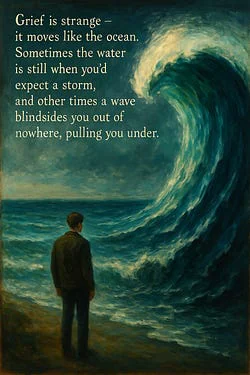
Grief is strange — it moves like the ocean. Sometimes the water is still when you’d expect a storm, and other times a wave blindsides you out of nowhere, pulling you under.
My twin was always different: sweet, innocent, but just different from other people. Not incapable, but someone who needed things explained in certain ways in order to catch on at times. Once he knew, he knew — it was just the getting-to-know part that was harder sometimes. I naturally and unintentionally filled large parts of this caretaking role for him, and in many ways it has shaped who I am — though I didn’t realize much of it until my mid-twenties.
His diagnosis came during what became a messy, confusing, and shocking period of my life. Interestingly, as that season unfolded, I began working with a therapist. I stayed with her for about a year. In one of our last sessions, she shared something like this that has stayed with me: “I thought it might be worth knowing that I have a brother close in age who was also diagnosed with schizophrenia when I was around your age. I didn’t realize it at the time, but looking back, that was one of the most chaotic periods of my life in the wake of his diagnosis.”
It was a strikingly profound moment of connection — realizing that for a year she had listened to me talk about my twin, my grief, and all the chaos that unfolded, while silently hearing echoes of her own story. I admire her for not rushing to connect through shared experience, for respecting me enough to let my story stand on its own and for me to make meaning of it myself. When she finally did share, it felt less like her story intruding on mine and more like a sincere gift of solidarity.
Regardless, I’m not here to tell a sob story. You deal with the cards you’re dealt as best you can. We’ve all got our burdens. At some point, each of us runs into an unexpected tragedy that carries transformative power — for better or for worse. As long as that calamity doesn’t permanently shatter someone, they can emerge wiser, more empathetic, and emotionally richer, with a newfound ability to feel gratitude for good times in ways that were once impossible.
What often gets missed, though, is that re-emergence in the wake of calamity doesn’t mean going back to who you were before. Calamity is not a pause button after which you resume life unchanged. It tears up the old blueprint. It has a way of dissolving the scaffolding you thought your identity rested on. The “emergent” self after is something different altogether, shaped by the hardship but not defined solely by it. You may carry more scar tissue, yes, but you also carry new panes of depth. Things that once felt small — for example, a laugh with a friend — suddenly carry different weight and texture.
To expand on this notion, imagine yourself as a plastic figurine. When catastrophe strikes, it’s as if the figurine is thrown into fire. At first, the heat feels purely destructive — parts crack, warp, or fall off. The shape that once felt fixed and permanent is suddenly deformed, unfamiliar. In that molten state, you can feel unrecognizable to yourself — a breakdown of who you thought you were. But heat doesn’t only destroy, it also softens plastic. The same fire that disfigures also makes the figurine malleable again. Only in that melted, undone form is there a chance to be reshaped into something better. The reshaping is inevitable — the figurine will cool into a new form as the fire abates — but what that form becomes depends on what you do. Left unmanaged, calamity can harden us into bitterness or sheer avoidance of the world. An enhanced mold requires patience, effort, and the humility to seek honest feedback about what shape it should take. With careful hands, the plastic cools into a new configuration — not flawless, but sturdier, more adaptive, more capable of meeting life as it is. And often, that new shape carries with it fresh ways of being useful to others.
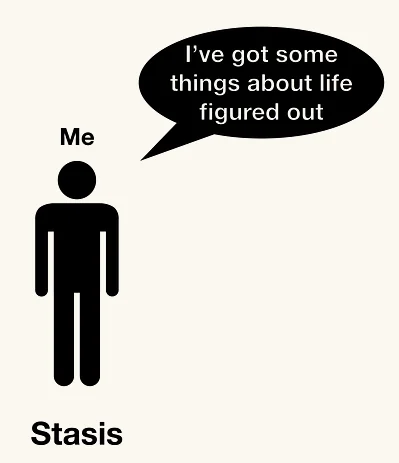

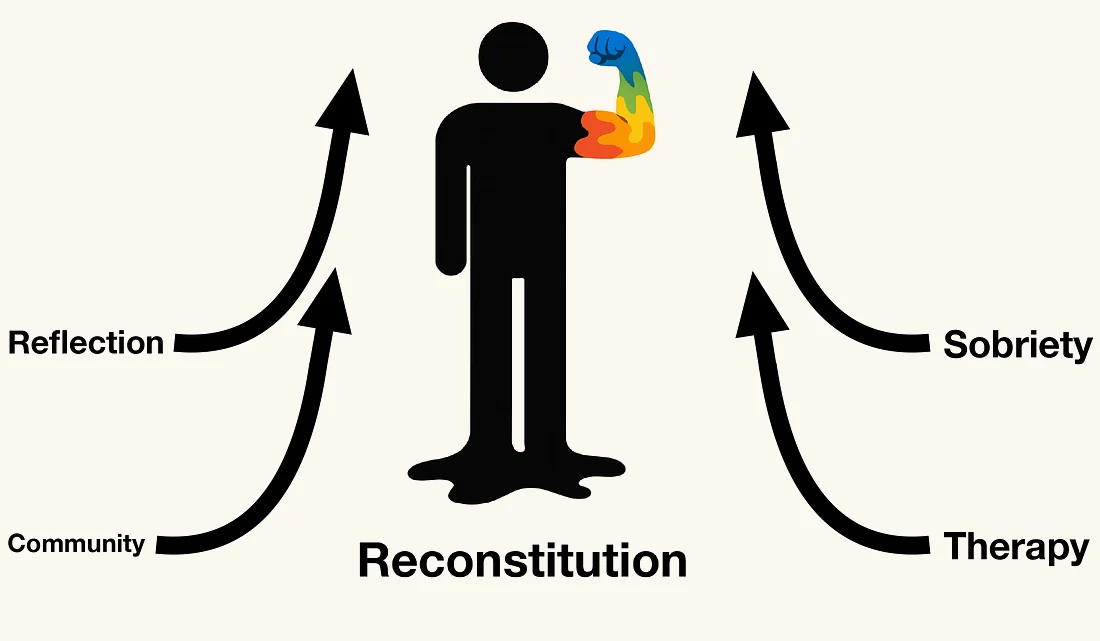
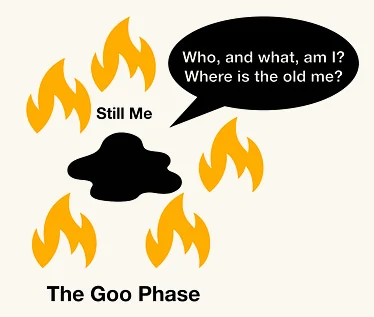
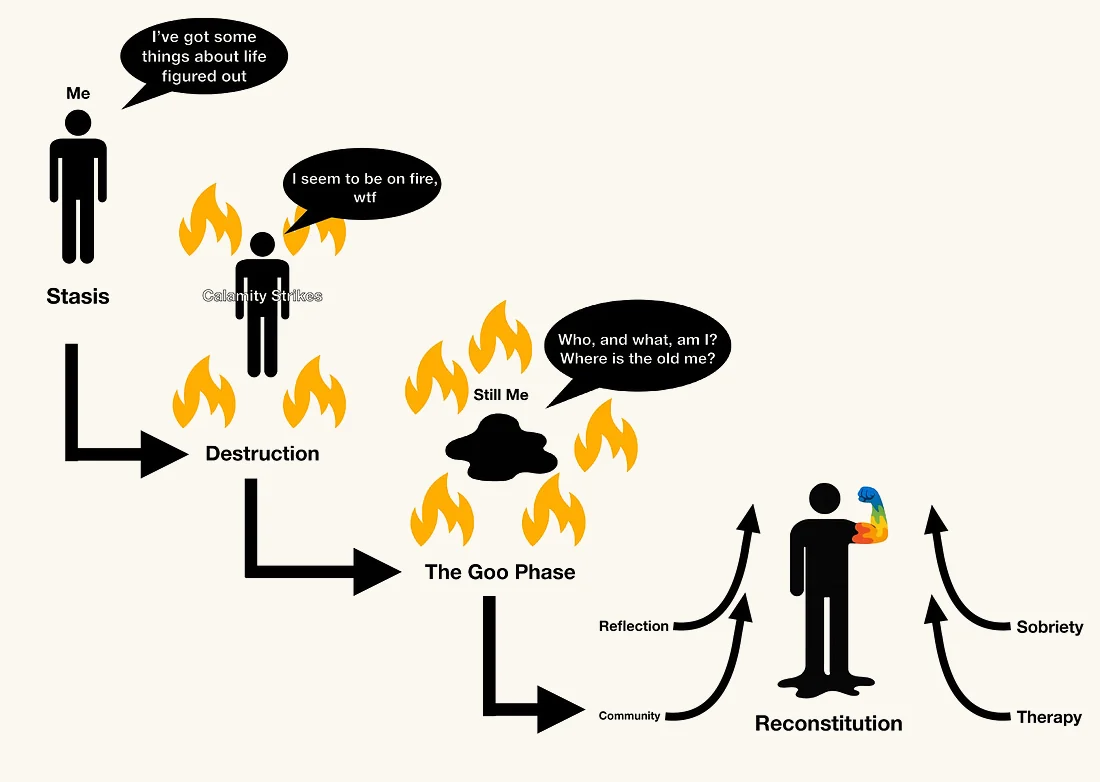
And so, what I do want to make clear is that what I have to say about schizophrenia is deeply personal. I could avoid the hard details, but they are the reality — and sometimes they are the only way to capture fragments of what such an illness means, both for those who live with it and for those who love them.
I cannot cure my twin, but I care about him and about this disease enough that I want, in some way, to be part of helping others who face it. Maybe that will mean direct work with people who suffer. Maybe it will mean contributing indirectly, through scientific research.
Hopefully, at minimum, I can share what I understand about schizophrenia in a way that makes it more accessible — to help demystify it, reduce stigma, examine how we currently treat it, and offer some thoughts on how our understanding might grow in hopes of treating it better in the future.
For example, One way to think about schizophrenia is that the barrier between what is internal and what is external fractures. For example, I know that I am typing on my laptop right now — that’s an external reality. And I know that I am feeling reflective — that’s an internal state. In healthy perception, these boundaries hold. My inner thoughts don’t spill into the outside world. The outer world remains distinct from my internal experience.
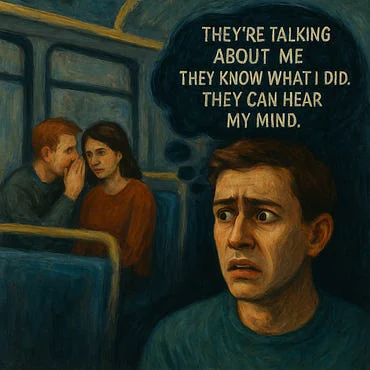
If this boundary breaks, inner experiences may be misattributed to the external world — a thought feels like a voice coming from outside, or an imagined snake appears as if it’s right there. Conversely, external events can intrude inappropriately into the inner world.
Imagine two strangers whispering on a bus. The whispering has nothing to do with the nearby person who has schizophrenia — it’s just external noise. But inside, they may experience it as if those whispers are about their private thoughts or actions: ‘They’re talking about me. They know what I did. They can hear my mind.” Instead of staying external (“just people whispering”), the sound gets pulled into the inner world and is given personal meaning that isn’t really there.
Writing about this is, in part, my way of loving my twin and feeling less powerless in the face of the cross he has been burdened with carrying — a small act of pushback against something that feels both unfair and beyond my control. It is also a way for me to process my own grief and make sense of things as a whole.
I’m not an expert or a doctor, but I do care. As the saying goes, people don’t care how much you know until they know how much you care. I’ve done a good deal of reading, listening,
interacting, thinking, and talking about schizophrenia since his diagnosis a couple years ago, along with some formal neuroscience exposure in academia during that time — and the good news is, for many with schizophrenia, the prognosis is more hopeful than society often assumes.
E D I T O R I A L N O T E S & A D D E N D U M S
1. I inquired with my twin on whether this was okay with him to talk about, and he is okay with it.
2. This is heavy stuff, but it is reality.