From the Substack web edition · Original text and illustrations

A year ago I was fresh out of rehab and had no clue what I was supposed to do next with my life, the only thing clear was that I needed to stay sober and continue addressing PTSD I was struggling with. I had left grad school. I had left the East Coast. I had no plan, no job, and a brother in Texas who welcomed my company, apparently. Somewhere between treatment and Texas, a mentor of mine commented that I needed to learn how to use my voice because I could help others with it.

Naturally, I started a podcast. And writing publicly.
Prior to this, I had always held myself back in a way. I spent most of my life running a background process that assesses what I think the person in front of me can handle, and if I were to be my full self, how much I could handle in return. I can remember feeling this way as far back as first grade. It’s just always… been there.
And then, having gauged the circumstances, I deliver something smaller and more contained than what I actually am to the person in front of me, or to the group I’m in at the time. Pervasive forms of “Don’t say that, they won’t understand,” and “I notice this, but others don’t.” To be fair, we all run some version of this.
There’s a third-ish one, and it has cost me more than either: “Don’t do that — I don’t want to stand out or make others feel smaller. I don’t want to upset the status quo.”
That one has governed more of my life than I'd like to admit. It shows up in how aware and capable I'm willing to let others know I am. Like a self-imposed car governor.
I didn’t have the courage to try and articulate this until recently for fear of being judged as arrogant, and I have always thought of it as reading the room in a way. Being considerate. Not overwhelming people. Keep the peace. Don’t want to be conceited.
Those are defensible framings, but what have I cost myself by shying away from what I am? What have I cost others by not pursuing the most helpful version of myself? It has nothing to do with thinking I’m somehow better than others — there are lots of people much smarter and more capable than me that have avoided being a repeat rehab participant.* My only hope has ever been to be capable enough to recognize my own limitations and stupidity.
There’s the loneliness of a person who learned early that the full version of himself was different enough to be separate from others in some sense, and the quiet acquiescence to limiting himself in order to connect with others well enough to not be lonely. Feeling different like that is assuredly related to how I ended up wanting to numb life with substances.

People have said things to me over the years about what they think I’m capable of that have absolutely floored me. What’s been strange to live through is that it kept happening across different institutions, and it happened more intensely as the rooms got more competitive, to the point where I’m doing what I’m doing out of faith in what has been said to me over the years.
In a way, this probably sounds like false modesty. So, let’s go back a decade-ish for context as to why it’s been strange for me.
A BRIEF RETROSPECTIVE
In August 2015, I began college at the University of Iowa as a student in the Tippie College of Business. I was from a small town, and didn’t have a lot of confidence in my abilities now being in a bigger swimming pool. I developed a drug addiction. It got really bad and scary. I couldn’t get out of the addiction, I was too scared to ask for help, and I didn’t believe help would work anyway.
I finally asked for help in October 2016. Hey Dad, I, um, have a problem. I dropped out of school. I went to rehab. After rehab, I went back to the University of Iowa for the spring 2017 semester. It went horribly. I remember having a panic attack in an introductory physics class because I wasn’t sure I’d be able to handle the material intellectually. I didn’t know how to do anything without Adderall, the world was terrifying. So, back to Adderall I went, to try and manage. It, predictably, did not go well.
I dropped out of the University of Iowa in March of 2017 — for the second time — to attend drug rehab in Minnesota, for the second time.
Imagine you’re lying in a bed in rehab at nineteen, going through withdrawal. You’ve told your parents you have a drug problem serious enough that you’re leaving school over it. Your friends all find out, and life will be different moving forward, there’s no going back. Experiencing that once was enough.
After the first rehab, you try to come back to your life and your friends, act like everything’s fine, and then crash and burn again. Here you are, back in a rehab bed, going through withdrawal. Welcome to your twenties, my guy.
Whatever confidence you had in yourself does not survive those experiences. How could I be confident when my best attempt at life had resulted in this? I lost all my scholarships and had been completely removed from the life I was expecting when I showed up at college.
I then spent the better part of a year in sober living on the West End of St. Paul, Minnesota. I was depressed, overweight, nihilistic, and shattered internally, learning the concepts and language to be able to describe what was going on with me. Somewhere in the middle of it I went to rehab a third time, in August 2017, and then went back to sober living. I failed, again, at the whole being sober thing, and closed out the year by moving back to Iowa to play video games and numb myself in my parents’ basement for a few months.
In January of 2018, not knowing what else to do, I started school at the University of Minnesota. I was still not sober the way I needed to be. I didn’t think I could perform well at school on drugs, and I didn’t think I could perform well off them either — by then I’d started to suspect I might just not be good at life. I liked science, though, and tangibility, and objectivity, and thought if I probably wouldn’t make it through school, I might as well go for something I actually cared about rather than business school.
RETURN TO PRESENT
That was the psychological floor I entered my twenties with. I’m 29 now. Climbing up off that floor has taken years and has not been linear, and most of that story belongs somewhere else. What belongs here is this: the comments and opportunities for what I could be never stopped. They came at Iowa while I was using. They came in sober living and treatment facilities. They came at the University of Minnesota. They came at Brown University, and after.
I have always filed these comments away without ever really picking them up, always prepared with a reason to brush them aside internally. There are a lot of people with a lot of potential — cool, dude. The time isn’t right. I need more experience before actually exploring what I can be. I need to be well enough to handle the responsibility that would come with it. Accepting the comments also felt too close to arrogance to sit with comfortably. Better to receive the compliment, nod, and move on. Let self-doubt win.
Two truths.
It’s never going to be exactly the right time to pursue something that will demand every part of you.
What people have said I could be has always scared me too much to reach for.
But I’ve been thinking about these comments differently lately. Not as flattery. Just data. And data, examined sincerely, often asks you to update your model. Refusing to look at data is its own form of ignorance, and it also isn’t humility.
The hard pill here is that pursuing a more realized version of me would make me noticeable in a way I couldn’t retreat from, and I would have to be visibly bad at things before I was good at them. And yet, accepting a more constrained version of myself has ended, reliably, with me swallowing pills.
So, this last year, I’ve been working on swallowing the hard pill. Who am I to say they aren’t right, when I’ve never really tested it?

SIGNAL
Fast-forward a year-ish from when I started the podcast. A clip crossed forty thousand views on a Tuesday. My first taste of semi-virality. By Thursday I felt worse than I had in months.
The numbers were real. Three hundred people reshared that clip. Strangers engaged in the comments in a way that told me they’d actually watched. I got my first hater comment, a true badge of honor. Within a short span, 250,000+ views landed across the clips I’d posted. For a year, I’d imagined some version of this moment.
I checked my subscriber counts across platforms. Not great. The thing that would eventually make this sustainable — subscribers, people who’d stay for more — had barely twitched.
So the moment I’d been hoping for had finally arrived, and I found myself sitting in my studio late into the night, lights still on, feeling like I’d been hollowed out with a spoon. Technically, this view-to-subscription ratio means I have a funnel problem. I worked through potential fixes on a whiteboard that night.
It didn't help at all. I felt like shit for a few days. Maybe the biggest part of that was fear — not fear that this wouldn't work, but fear that what I've been aiming at is actually possible, and what that would mean going forward.
THIS LAST YEAR
Let me be specific, because the specifics are the whole point.
I’ve been building something alone for about a year. It is also the first time I’ve made it a year sober, which is a whole journey unto itself. When I say building alone, I mean alone. Not “alone” the way founders say it when they really mean a small team. I mean I’m laboriously carrying a picture of something that I haven’t been able to get anyone else to see in full yet.
I mean countless conversations where I mention that I have a podcast and a Substack and watch others not register an ounce of my commitment level and the sacrifices that have come with it. I mean I reach out to strangers I have no business reaching out to. Most don’t reply. I book the guests. I write interview prep briefs — real ones, papers and books read straight through, for opportunities that may never materialize. I run pre-interview calls over my lunch break at my job. Instead of music on my runs, I listen to guest prep materials and talk it through with an AI. I wake up early on Saturdays to read about interviewing tactics and grind through content-creation basics — covering, and capturing, someone’s material well demands competence across a dozen different skills if you’re working solo.
It’s hard. If you want to do something unusual, you have to be willing to sacrifice unusually to get there.
I have, by and large, given up dating. I set up microphones and lights on massive stands in a room I acoustically treated myself, measuring and cutting panels by hand. I read the DaVinci Resolve manual. I learn how to work in Photoshop. I edit on my laptop on the stationary bike, to the amusement of my gym fellows, who offer regular commentary along the lines of “Don’t work too hard, man.” I tape the interviews. I convert iPhone footage from variable to constant frame rate through a terminal command so it aligns with my microphone audio. I learn how to engineer audio for better sound — a high-pass filter here, a noise gate there. I adjust the color grade at two in the morning. I lose a flash drive with hours and hours of work on it. I have to redo it all. I do that. I learn to store backups, always. I write, and write, and write, but most of it remains unpublished because I can’t find the time to revise it the way I’d like, and I tolerate that frustration. I take vacation days from work to sleep in an airport with my equipment so I can interview someone who isn’t local, and I love every fucking bit of doing it.

I take more vacation days to drive to Houston at six in the morning, pop a tire on the way, and end up sweating in an auto repair parking lot, rehearsing aloud the questions I want to ask Dr. Carla Sharp in a few hours. Please, sir, hurry up with my car, I must make it to Houston on time. I stop watching movies and shows, one of my favorite things in life, to give myself more time to devote to this. I design systems that produce infographics and scientific visuals on demand, and feel the sting of not having enough time to use that capacity fully.
(Un-utilized infographic examples).
I trade quality time with friends and family for the hours it takes to get good enough to do this right and feel the sting of that, too. I devise a written day-of-interview protocol to get myself in the right headspace and keep from tripping my own PTSD wires. Get enough sleep, caffeine, treadmill, kava x minutes before with pharmacokinetic considerations, meditate, review prep materials, setup, go time. With interviews, you often only get one chance in a limited time window.
I painstakingly watch and listen to myself and log my errors. Stop interrupting. Sit in the silence longer. Keep your head still. Cut kind of, might, like, and you know from your vocabulary. Stop hedging and prefacing so much. Be more prepared so you’re more confident. For travel interviews, arrive earlier so it’s not DEFCON1 getting everything set up. An abundance of self reflection along the lines of, “Yeah dude, you fucked that up.” I fly someone in to practice hosting a guest. I design the episode artwork. I cut the clips. I write episode companion essays. I intentionally post content that makes me uncomfortable to keep training myself to be more comfortable letting others know me and see me openly. I embarrass myself. I try to tolerate the discomfort of all of it in conversations with my therapist.

A year ago, publishing this would have terrified me. It doesn’t now, because I’ve practiced this repeatedly. Vulnerability is just allowing others the opportunity to judge you, and it’s a discipline that’s trainable.
And I do all these things again. And again. And again — I am an addict, after all.
Twenty-two episodes. Listeners in thirty-six countries and counting. Fifty people subscribed to this newsletter as of a few months ago, which is fewer people than were in my high school graduating class in Tipton, Iowa. Almost the same, though.
The mentor who told me to use my voice never specified to whom.
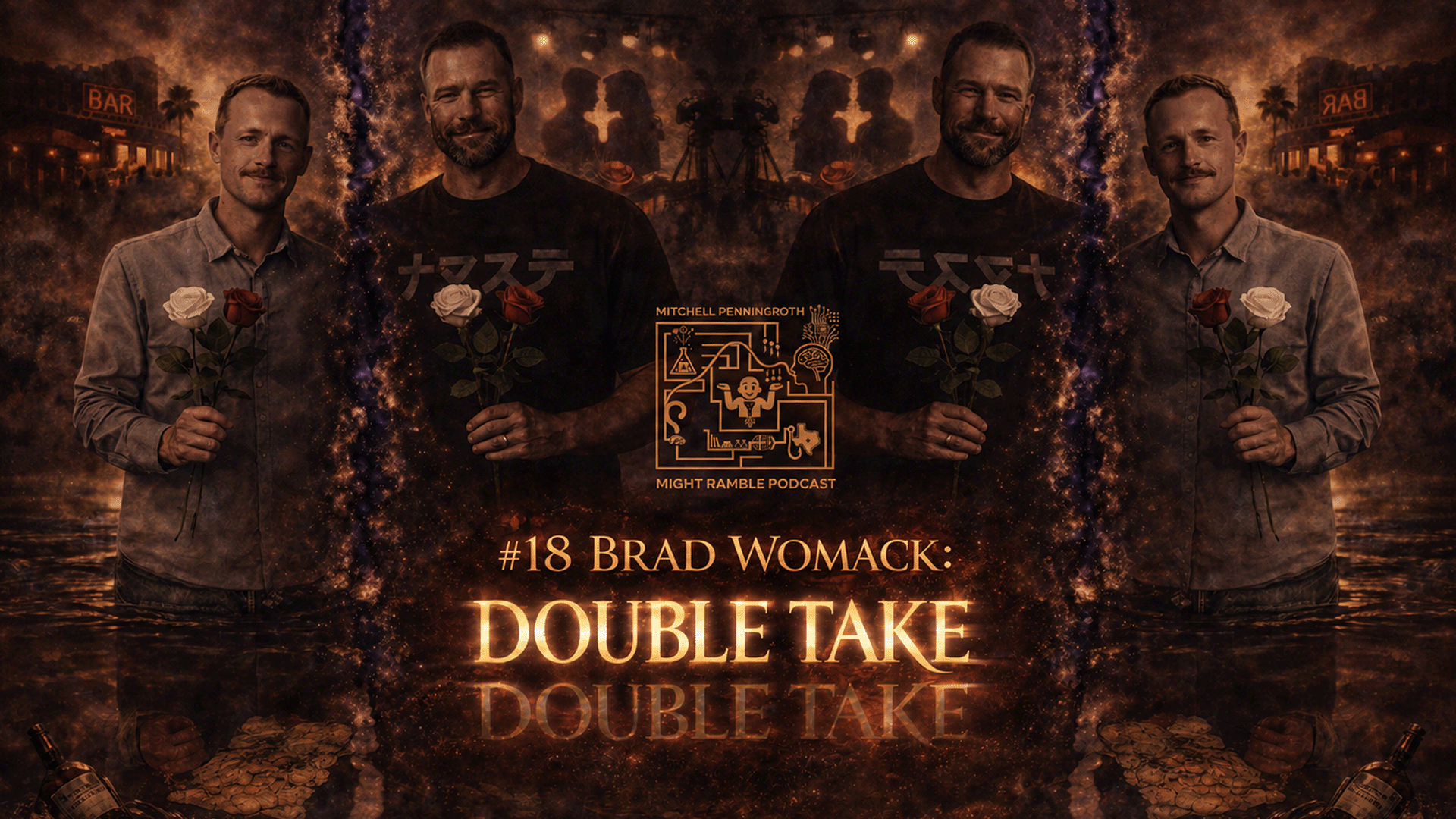
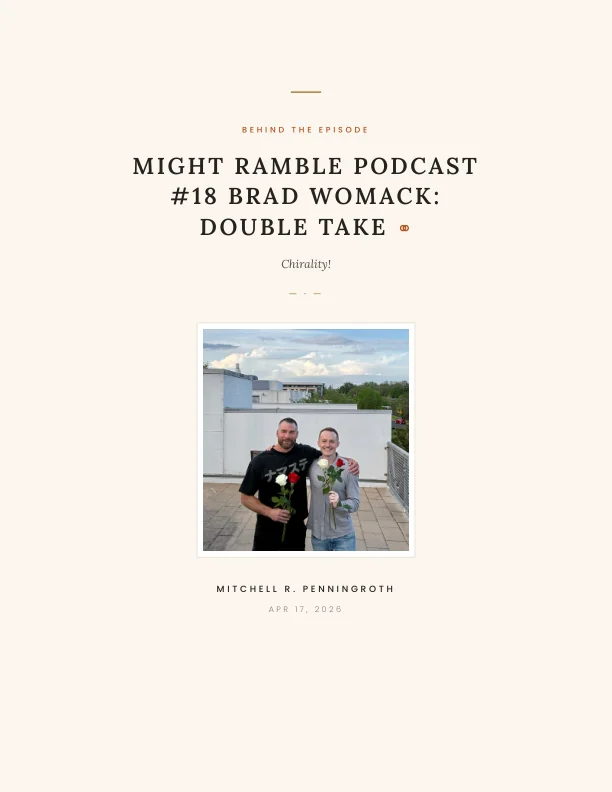
Somewhere in that same year, the clinical director of addiction research at the NIH’s National Institute on Drug Abuse sat down across from me for two hours. I didn’t even have a bedroom at the time. A world-renowned personality disorder researcher I’d written off as a pipe dream came on the show and talked to me like a peer — a year prior, in rehab, a counselor recommended I seek out Dr. Carla Sharp, so I did in the most visible way possible. I interviewed a guy who was The Bachelor twice, and he thanked me for the opportunity. I later went to his apartment, collected files on a flash drive, and talked about the intricacies of our families like this is somehow normal. I interviewed one of Victoria Beckham’s favorite models, having absolutely no idea what I was doing. People keep listening to that episode, and I’m so embarrassed about the production quality of it now. The chair of a local neuroscience department and his wife had me over and cooked me dinner, wanting to know what I plan to do with my future and how they can help. People have reached out and donated thousands of dollars to keep this going. I have had letters, emails, and comments thanking me for the work, and donations made to charities in my name and my twin’s. The author of a famous book I read right after rehab — one that helped keep me sober — recently emailed me. She declined to come on as a guest (too busy right now), but said, “Keep going,” a refrain I’ve heard often this last year.
Still, I have, at an early stage, dived right into stigmatized topics that carry professional risk for me. A senior employee advised against hiring me because, “He has a podcast about schizophrenia”. (My podcast is not about schizophrenia, and my rationale for exploring the topic is well-rooted.) I knowingly bear the weight of this stigma, and proceed anyway because I’m convinced it’s exactly what I should be doing. My intentions and aims are clear to me. A different mentor once told me, “Live by your values, despite the consequences.” I think about that a lot. I also think a lot about this quote from Dr. Marsha Linehan, perhaps one of the most badass quotes I’ve ever heard.

So, the ledger reads: wildly accomplished academics taking me seriously, funding from people I wouldn’t expect, access to individuals with large followings and influence, publicly navigating highly stigmatized territory, and a regular audience that could fit in a Denny’s, where I once practiced the art of setting up my recording equipment while maintaining a conversation with my therapist.
I could not have designed a better machine for making a person feel insane.
WHAT IS ACTUALLY HAPPENING
I went looking for the literature on the internal experience I’m describing, and found relevant material. “Lonely” is the word we reach for with someone in my shoes, but it’s not quite the right term. There are several distinct things happening simultaneously, yet they only feel like one thing from the inside.
1. The scaffolding is gone and you don’t notice until it’s gone.
Self-determination theory (SDT) says psychological wellbeing runs on three things: autonomy, competence, and relatedness. Autonomy is acting on your own reasons. Competence is the sense that what you do actually works. Relatedness is being known by people who matter in the context of what you’re doing, and mattering back.

Institutional life, whether it’s a lab, a company, or an academic program, gives you all three pillars at moderate levels. Remove the institution and go independent, and autonomy goes to the ceiling while competence and relatedness fall through the floor. Relatedness collapses because you lose the direct peer group (the people on your same timeline facing your same problem). That peer group is a different resource compared to, say, friends who love you. My friends love me, but they cannot tell me how it feels to show up and meet someone influential for the first time while needing to control the room well enough to interview them properly. I don’t have a peer who can tell me what it was like to walk into a room and meet Dr. Carla Sharp for the first time, and within minutes be telling her we need to do x, y, and z when it comes to the set of topics she’s dedicated her life to.
2. Competence doesn’t necessarily drop. It becomes unmeasurable.
This is the one that took me longest to name. In graduate school someone graded me. There was a committee. There were deadlines that meant something. Out here the only feedback is the market’s, plus input from people who know you but have never been in your shoes. Market feedback is sparse, lagged, noisy, and confounded by distribution effects that have nothing to do with whether the work is any good.
For most of this year I could not distinguish between “this isn’t working” and “this hasn’t worked yet.” Those are completely different situations, but they feel identical internally.
It’s like you’ve chosen to run a race alone and blindfolded. You’re passionate about running it, but there are no mile markers, no finish line, and you don’t know the route. You start running. People think you’re out for a jog. An unexpected one, maybe, but just a jog. You keep running. You’re passionate about it, but you still get tired. You want water, maybe some carbohydrates — at this point you’d welcome even the specific hell of a porta-potty — but you’re blindfolded. You just keep going.
Am I about to run into a hill? Are there rocks over there? How long until I cross something like a finish line and get a reprieve? Does anyone understand what race I’m running? Does anyone care that I’m running this race? How am I doing in this race?

There’s a body of work on intolerance of uncertainty suggesting that the unresolved question — is this working? — is itself the stressor. The idea is that the nervous system treats a prolonged open question about your status roughly the way it treats bad news. That definitely tracks. A clean rejection is easier than enduring a year of “Am I on the right path here?
3. You’ve made a claim nobody has ratified.
Role identity theory has a phrase for this: the unverified identity. I started calling myself a podcast host and a writer before anyone agreed. Every time I said it in conversation and watched the face do the thing — the polite pause, the “wow, cool hobby,” the swift pivot to the next topic — that was a small failure of verification. Do that a few hundred times over a year and it wears a groove.
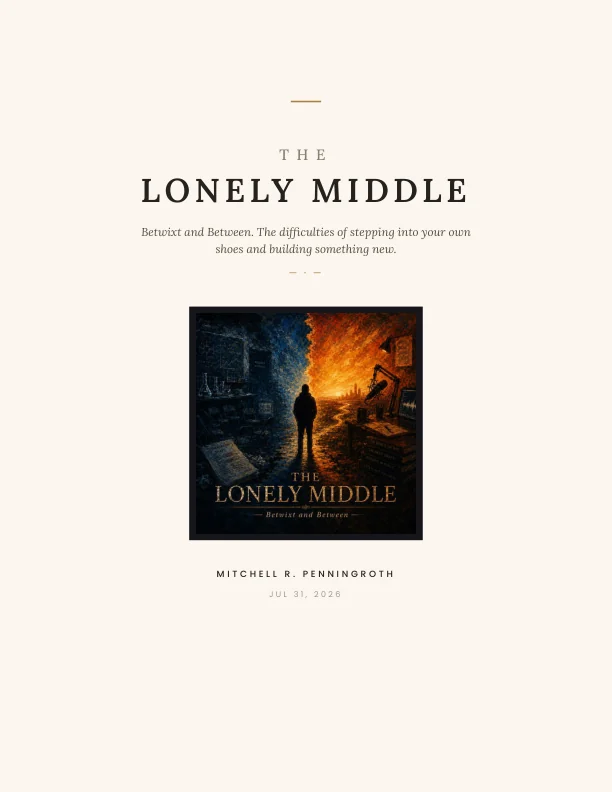
Which brings me to the phrase of interest here. Anthropologists studying rites of passage describe a middle phase every transition has to pass through. You’ve shed the old role and haven’t been granted the new one, and in that interval you’re structurally ambiguous. Betwixt and between, belonging to neither category. That’s it. That’s the thing. I’m not the chemist with the 9-to-5 anymore, and I’m not yet harmoniously accepted as whatever this is.
The difficulty is working past the threshold where others treat you as illegitimate in a new role. In traditional rites of passage, the liminal phase was deliberately held communally. The initiate wasn’t left alone in it, because everyone understood that being alone in it is the dangerous part.

4. You can’t only work on it when it feels good.
Even if you’re deeply passionate about what you’re building, if you only work on it when it feels good, you won’t get much of anywhere. Again and again, you hit a juncture where you have to re-decide whether something this inconvenient and uncomfortable is still worth it. I love what I’m after here, but most of the work happens before or after a 9-to-5 — which means most of it happens when I’m tired, or in time slots where I’ve had to say no to normal activities.
5. The spike doesn’t fix any of it.
Hedonic adaptation is well established: the emotional charge of good events fades toward baseline faster than we predict. Combine that with a reinforcement schedule where progress arrives as unpredictable spikes against a silent baseline (intermittent reinforcement) — the most motivating and most destabilizing schedule there is — and you get exactly what happened to me on that Tuesday. The win got metabolized quickly. I now had vivid proof of reach. Validation raised the stakes without settling them.

6. Crab Theory
There’s a folk idea that fits here. Crabs in a bucket don’t need a lid. Any single crab that gets a claw over the rim gets pulled back down by the others, and none of them get out. It's not a scientific finding, but there's a real mechanism sitting underneath it. Abraham Tesser spent years on what he named self-evaluation maintenance, and it works like this: when someone close to you outperforms you in a domain that’s central to how you define yourself, it can prompt uncomfortable self-reflection, so you respond by distancing yourself, deciding the domain doesn’t matter, or making their continued performance harder. And closeness here isn’t just friendship — it can be similarity, proximity, anything that psychologically links you to the other person. If you start branching out and fulfilling new roles successfully, not everyone around you will react positively to it. You meet resistance when occupying a new unratified role.
There’s been a weird flavor to it. The people furthest from me, or newest to me, have been the most accepting of who I’ve been for the last year. The people who know me best are supportive and not surprised. The people that love and truly know you remain just the same. The friction comes from people who were familiar and friendly with me before all of this, but not close enough to truly understand me (and vice versa). Also, most people simply aren’t thinking about me at all. But there are people who notice and get strange about it, and it’s something you can feel.
Sobriety taught me the harder version of this first. When you quit, some people are relieved and some people go quiet, and the quiet ones are usually the ones who used with you. Quitting represents an accusation you never made.
The thing recovery taught me first
This year of building has run exactly concurrent with my first year sober. This project started partly as something to grasp onto while I made sense of myself. A structure, a reason to be up early, a thing that needed me to be intact in order to happen. It has become something with much higher stakes than that. But the origin is the origin.
And the podcast and sobriety are different flavors of the same problem.
In recovery you don’t get to know it’s working. Yeah, you know if you’re sober or not, but being sober today is not enough to stay sober. There’s no scoreboard that tells you you’ve won, because you don’t win. You accumulate days, and the days don’t compound into certainty of a life worth living. The counting is a trap if you let it become the point. You do the next right thing without confirmation that the next right thing is doing anything, really. Anyone who’s been through it knows the specific vertigo of a good stretch, when the absence of crisis starts to feel like evidence you were never that bad, or that you’re all good now.
That is precisely the epistemics the lonely middle demands. Process conviction without outcome certainty. Do the work, then do it again, on the grounds that you believe it’s the right work, not on the grounds that you’ve been shown proof that this input will result in a certain output. Self-esteem requires evidence that you’re doing well. In the middle of taking on a new role, that evidence is exactly what’s withheld — so if your stability is built on it, you’ve handed your footing to something you don’t control.
I did not arrive at many of my thoughts here through scientific literature. I arrived at them sitting in church basements and rehab facilities, and then found the science later and thought, “Oh! This is that.”
The Might Ramble Relay
There’s a segment on the show I’ve never explained in writing. I refer to it as the Might Ramble Relay. At the end of each episode the guest asks a question that the next guest answers. It builds a chain across episodes.
The rule I’ve intended is that the asking is done blind. The guest doesn’t know who’s coming next. Nobody does — often I don’t either. You ask into the void, for whoever shows up.
I didn’t design it as a metaphor. I thought it would be a cool way to represent the idea of connecting people who normally wouldn’t mix, and to build a conversation across time amongst people that may never meet. But I’ve been thinking about this since that Tuesday when semi-virality came my way, and I think it’s the most accurate description of this year I’ve got. You put something specific and real into a space where you cannot map out the exact path ahead, and then you keep going, on the belief that it will land wherever it’s meant to land.

Update: I kid you not, 45 minutes after publishing this, 50% of my company was laid off for reasons completely unrelated to this article, including me. What timing!
*Rehab is just an adult timeout, really. I don’t recommend the circumstances that lead to rehab, but living simply in community and discussing your life with others for a month+ is a one-of-a-kind experience I recommend.)