From the print edition · Original text and illustrations
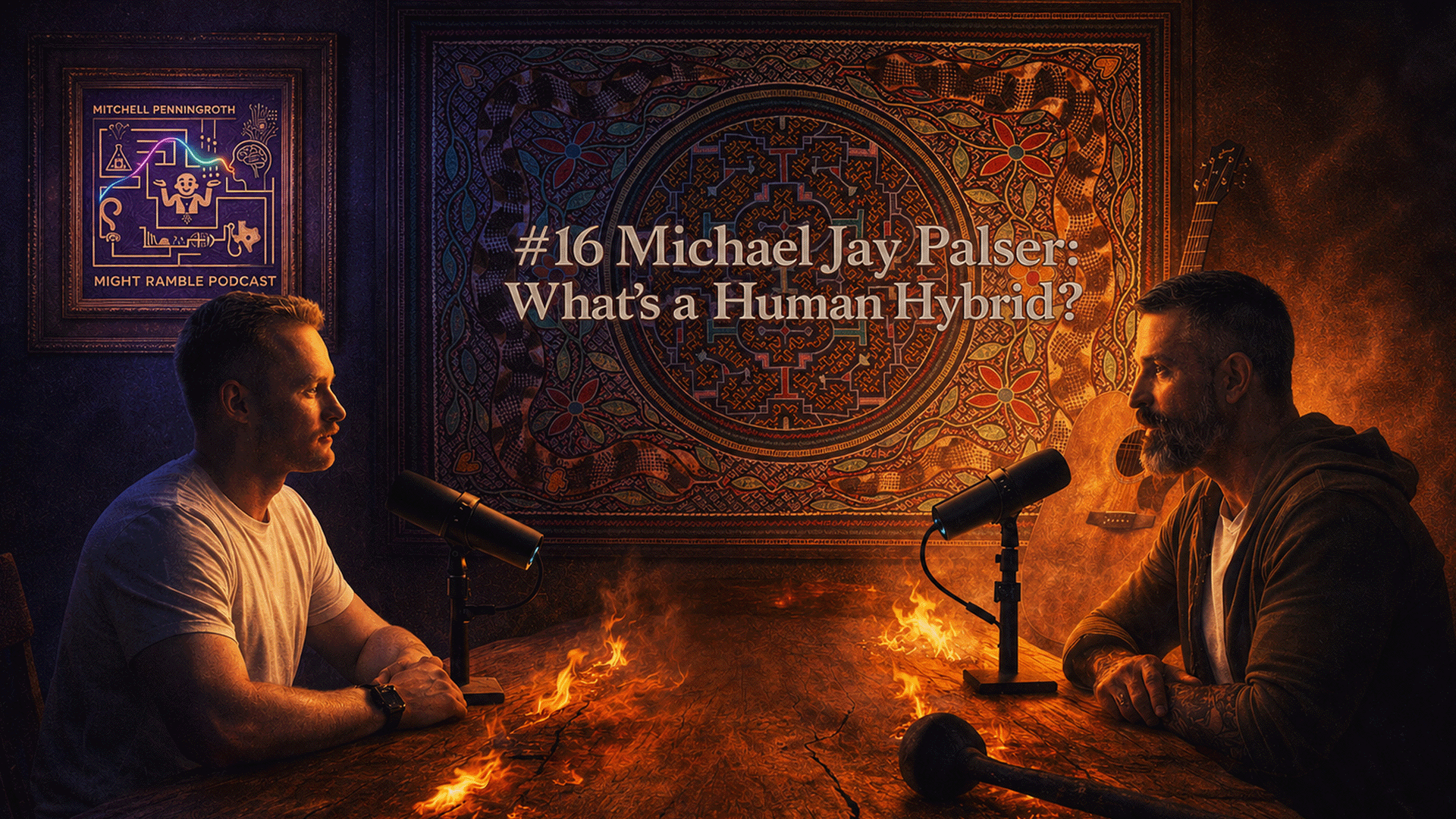
This episode was recorded in Michael’s space. His home turf. There’s a Shipibo tapestry on the wall behind us — intricate, geometric, vivid, and apparently the kind of thing you see in ayahuasca ceremony traditions. News to me. Snakes are winding through a mandala (I’ve got an affinity for mazes, apparently.)
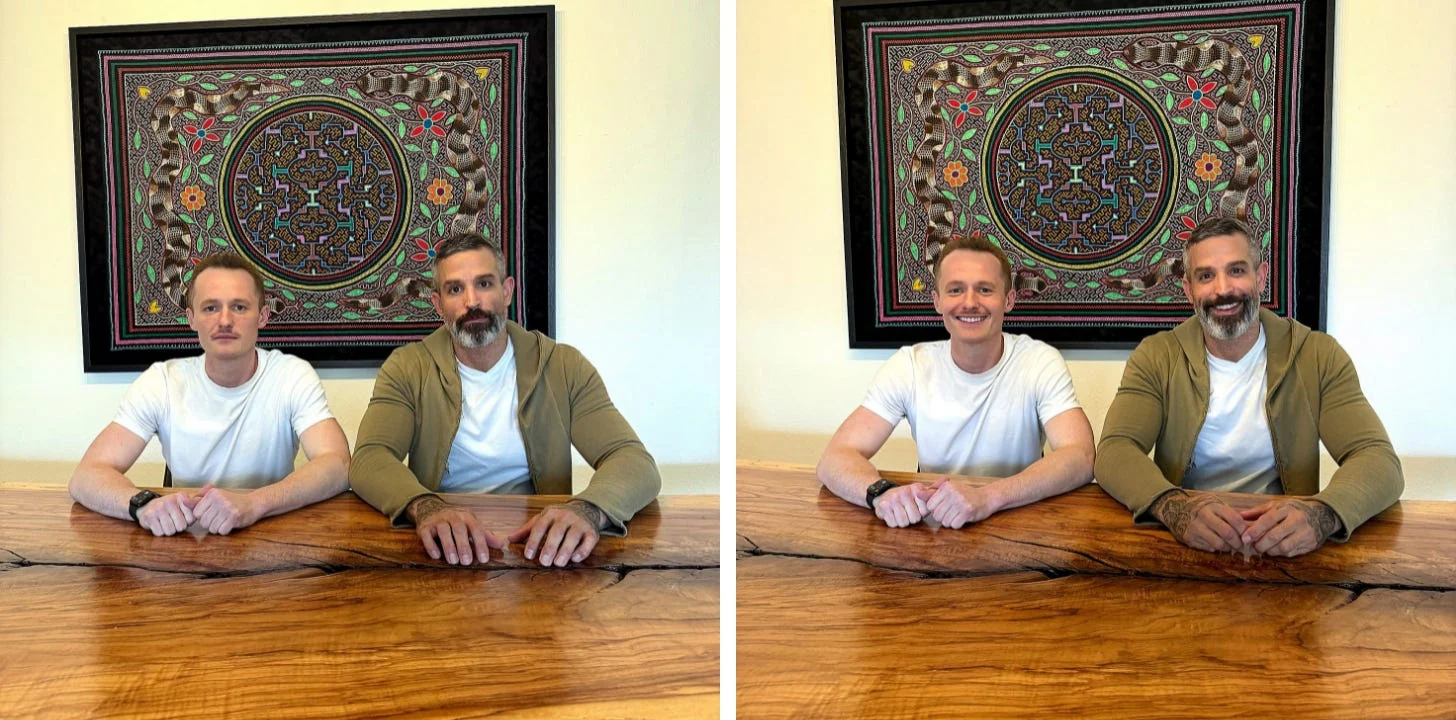
The tapestry is assuredly not decorative based on what I know about Michael and the degree to which he is intentional with his life. It means something to him, although I didn’t ask what that might be.
We’re sitting at a live-edge wooden table. Big slab, natural grain. Live-edge tables retain the natural, raw edge of the tree — curves, knots, grain. Imperfections and all. Retention of the essence of the tree. Preservation of originality and identity, themes Michael has explored in his career as a coach, musician, and in his recent book Becoming.
Michael is barefoot, literally grounded. I’m in a white t-shirt. So is he. We have microphones between us. Although not pictured, I sit on one edge of a very long table, and he sits at the other end. This table was so long, truly. We’re quite a ways apart. I’m about to record a podcast, and I’m thinking this is so much like Vladimir Putin’s meeting table, while reminding myself do not bring up geopolitical happenings in this conversation with Michael. Nervous, thinking about Putin, and without my usual colleague who helps me set up equipment and make sure everything is recording properly — just where I want to be to begin a podcast!
So it goes.
That’s the scene.
And then the conversation starts. In the artwork, you’ll notice the table is on fire, yet we’re sitting there calmly.
Chapter 5 of Michael’s book Becoming is titled Apó Fotiá — Greek for “from the fire.” In it, he describes the period when he was drinking every night, coaching other men on discipline, and hating what he saw in the mirror. His word for it: hypocrisy. He looked strong on the outside while collapsing on the inside.
I know what that’s like.
Michael and I both had a rock bottom. An instance where the cognitive dissonance between who you are and who you’re pretending to be finally collapses and you have to face yourself earnestly.
That’s what the fire symbolizes. Fire shapes. It carries both destructive and constructive potential depending on how it’s wielded — a house burning down versus a forge. But for whatever is being shaped by fire, it’s painful. Parts of what you thought you were are lost in the process. Parts of you that you thought were necessary. Fire tears up the old blueprint.
Michael talks about being “dangerous in the right ways.” I think that’s exactly right. When you’ve seen who you’re capable of being under the wrong circumstances — the version that drinks every night while preaching discipline, the version that smiles in public while dying inside — you carry that knowledge forward. It gives weight to every choice that keeps you from going back to that version of yourself.
That’s what “dangerous in the right ways” means. Not aggression, but the fierceness of someone who refuses to slide back into who they were — and the urgency of someone who knows this found slice of freedom isn’t guaranteed in perpetuity. When you’ve been on fire and you’re finally not, you don’t sit around basking in the cool air. You move. You go after what you care about with a seriousness you didn’t have before, because you know the reality of losing the ability to go after anything at all. That’s the “danger” — not recklessness, but the refusal to waste a life you almost didn’t get to keep.
In the artwork, the fire is between us to symbolize a shared understanding of it, and representing where much of our conversation lived.
Also in the artwork:
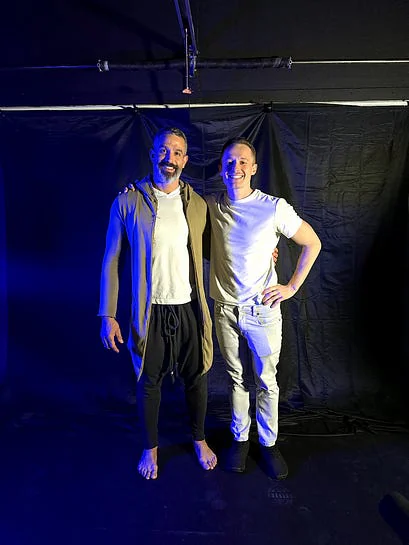
• The room is split — left side in shadow, right side in golden light. That’s deliberate. I got this idea from a picture Michael and I unintentionally took where the lighting only covered just over half of our faces (see above). In that picture, the unlit side represents our shadow selves. The lit side represents what’s larger than that. Despite knowing what’s in the dark, we’re smiling.
• There’s a dusty guitar in Michael’s corner that almost blends into the lighting behind Michael, or ahead of him, if only he’d look in that direction. Michael was a musician when he was younger, and bitterly swore it off long ago. Michael is getting back into music, and I wanted to place the guitar on the lit side for that reason. At the end of our conversation, he picked up a guitar and sang (he’s really good).
• Near Michael on the table, there’s a mace that serves two purposes. It represents both Michael’s mastery as a functional training specialist, and also how Michael and I crossed paths — Onnit gym (now Korrect Fitness), home to the use of such instruments of fitness.
• The Might Ramble logo sits in the upper-left corner. Every episode’s artwork carries the full logo. It’s a rule I’ve set for myself. The maze is the show — for me as much as for anyone listening. You enter, you might get lost, you might find something useful. The logo never gets cropped or hidden. It’s always the whole thing. It’s me always trying to be me.
• Michael and I both unintentionally were wearing white shirts, which is quite fitting in representing both of us as “clean” or “washed anew” versions of our past selves.
Listen to #16 Michael Jay Palser: What’s a Human Hybrid? wherever you get your podcasts.