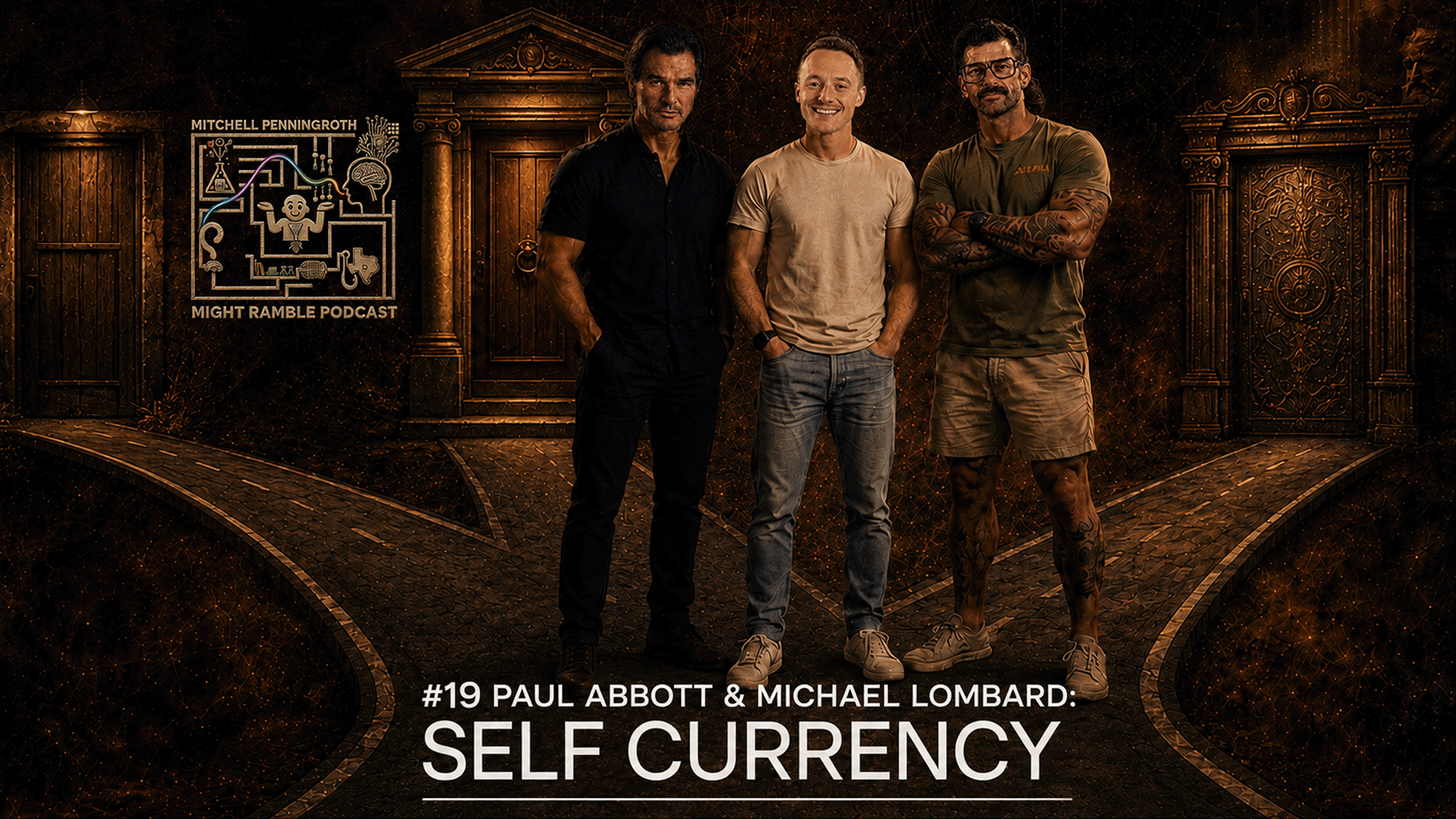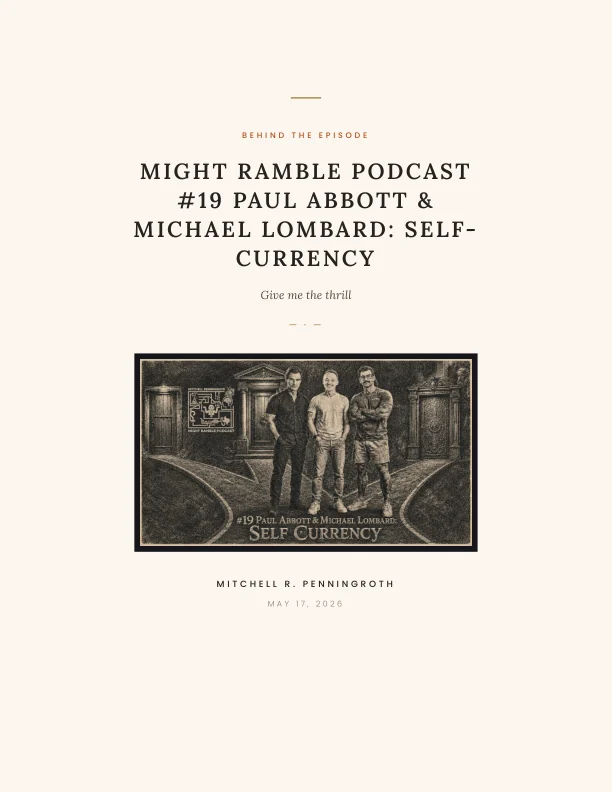
From the print edition · Original text and illustrations
I was going to record an episode with a guest I’d been preparing for. A few days before our scheduled recording, we rescheduled. I figured I’d just shift my prep to my next scheduled guest, like a sane person.
This is… not what happened.
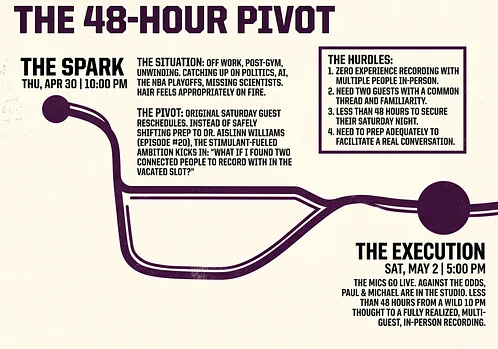
Less than 48 hours before recording with Paul and Michael, the idea for this episode was conceived. I’d gotten off work, hit the gym, eaten dinner, and was trying to catch up with the world — politics, AI, the playoffs, another war in the Middle East, the missing scientists…. you know. I do my best. Hair on fire most days, and a pretty normal weeknight for me.
And then, as a good former stimulant addict would do (give me all the thrill, please) at about 10pm I wondered: what if I found two people to record with in the slot that had been rescheduled?
This was, perhaps, too ambitious an idea on several fronts:
• I had never recorded an episode with multiple people in person.
• I needed two people with some familiarity with one another and some common thread between them.
• I had less than 48 hours to find these two guests and convince them to give up their Saturday nights.
• I would need to prep well enough to facilitate a useful conversation within said timeframe.
• I recently moved and I was not exactly settled in as far as a recording space. Time would need to be spent there too prior to recording.
Was this…possible? On paper, no chance. However, Mission Impossible does need a successor, so, leave it to me.
Was this…smart of me? ¯\(ツ)/¯. Someone once told me, in an effort to insult me within the context, “I wouldn’t call Mitchell smart… he’s just really good at organizing information.” Hard to argue. So here I was, at 10pm on a Thursday, organizing information.
Still, at every step before recording, the same thought:
Mitchell. For the love of God. Why? Just chill, my man.
Even my dad noticed. He recently asked me, “Do you ever just… chill and take it easy?” One of my prouder life moments — working hard enough at something that my dad, notorious workaholic, asked me if I needed to chill. I told him I’m a man on a mission.
And yes, I could have relaxed a bit in the days leading up to my next scheduled guest. The NBA playoffs were on. LeBron’s basketball days are numbered. The new Peaky Blinders movie was right there (I’ve missed you, Tommy Shelby.) A bath and a book… and perhaps a burrito. Mmm. Sign me up. Sam Harris had dropped a new Making Sense. All right there for the taking.
The sacrifices one makes in the service of content creation. Even my dating life has been relegated to the realm of nonexistence, in service to this work. So it goes.
Gotta be a man of the people!
Thus, I set off to make this happen.
DMs went out late on a Thursday night. I waited with bated breath.
Responses came back fast. Mike Lombard. Paul Abbott. Both fascinating in different ways, both people I’d been wanting to talk with. Luckily, within an hour of the idea hitting me, I had my guys. Locked and loaded. Both clearing a Saturday night for a dude they knew just a bit, on short notice.
Here’s what I assumed: Michael and Paul knew each other. We all train at the same gym. They’re both exceptional and hard to miss. If I knew both of them, they surely had to know each other. They’ve been around the community longer than me, it seemed a foregone conclusion. Duh.
I was wrong. They didn’t know each other. Not really. Perhaps a few nods across a sauna. Names half-recognized. That was the extent of it.
I didn’t find this out until they were sitting across from each other in my still-being-built studio. By then it was too late to plan around. So we didn’t.
Paul Abbott is one of the more interesting people I’ve had the chance to spend time with. In his 60s now. Fit as anyone half his age, was raised on the move. His father’s career sent the family across the country every three years. He lives in Austin now, but he’s been a lot of places, and you can hear it. He’s been in real estate, finance, sports, philanthropy, entertainment. He sits on the board of the Caitlyn Jenner Foundation. He goes by “Chief” — a nickname earned at college that stuck because everyone who’s spent time with him understands that there’s no other word that fits as well. Paul’s defining quality is that he’s exceptional with people. Not in a slick salesman way. In a way that makes you feel, sitting across from him, that he’s actually paying attention — to what you’re saying, to what you’re not saying, to what you don’t yet know you’re saying. He’s been around money and power and is utterly uninterested in performing either. He calls this stage of his life “Act Three” and treats it the way he treats everything: with curiosity.
Michael Lombard is a different kind of exceptional. He grew up in Waterbury, Connecticut, the great-great-grandson of one of the first motor carriers in the country — a family business that built itself out of horse-drawn carriages in 1923 and got killed by federal regulation in the 1980s. The Lombard name still sits on a strip plaza in his hometown. Mike served four years in the Marines, deployed to Afghanistan, came home, drifted, and at 28 weighed 280 pounds. Then his closest friend from the Marines died unexpectedly, and Mike decided to make a change. He moved to Texas, got his CDL, drove eighteen-wheelers for three years while training for marathons in truck stop parking lots, and rebuilt himself into the kind of person who runs 18 miles to kick off the day, and a 3 hour podcast that night without mentioning the fact he ran 18 miles that morning. He’s completed 3 ironmans. He hosts his own podcast, advocates for trucker health, and works in freight tech. He is unselfconscious in a way that’s rare in any room. Mike does not perform. He just shows up, and he keeps showing up, and over time the showing up is the thing.
My thoughts as they both arrived to record:
Perhaps you’ve pushed the envelope too far too fast here, Mitchell. No takebacksies now. What are we going to talk about? Have I engineered some sort of a social experiment here?
Like I said: give me the thrill.
What I’d intended to be a conversation between two friends, facilitated by a third, became something else. Two strangers. One inexperienced multi-person host holding the rope between us all in an unfinished studio.
Here’s what I learned: the multi-person format is more forgiving than I thought, and harder than I thought, in different ways than I expected.
More forgiving, because two strangers with no shared history don’t have to perform familiarity. They can just talk. They were curious about each other. They asked each other things people who already know each other have stopped asking. They asked questions the audience would want to ask.
Harder, because there’s no shorthand. No inside jokes. No threads to pull from prior conversations. When you know people, you have a felt sense of the next move — who will pick up which thread, who will pivot, who will go quiet. With strangers in the room, that predictive sense isn’t available. You’re improvising the whole conversation, including your read of who they are.
What I didn’t plan for, and what I think makes this episode the one it is, came in the back third.
I asked them both a question. I framed it as a question for them. Do you ever have to remind yourself you’re different from other people? Both of them answered. And then somewhere in their answers, Paul looked at me and named what I was actually doing. It sounds like you asked this question to get an answer. Like you’re not 100% sure about your difference.
He was right. I hadn’t fully seen it until he said it.
What followed is hard to summarize, but two men I’d booked as guests spent the last twenty minutes of the recording turning host into subject in the best way. A more experienced host would probably have seen it earlier and steered into it deliberately. I didn’t see it until it was already happening. That might have been the right kind of accident. Steering into your own inversion is not the type of dynamic I’m aiming for. Letting it happen, and not flinching when a guest reads you accurately on the air, is something that can differentiate a conversation if it happens organically and not too frequently.
I’m not sure this could have happened with two friends in the room. Friends would have laughed it off. Two strangers, with no social cost to telling the host what they were seeing, just told me. I think the format I stumbled into is the one that produced the moment. Which means the assumption I got wrong — that Mike and Paul knew each other — was the assumption that made the episode.
I don’t think you can plan for that. You can only put the right people in the room and stay out of the way enough for the room to do what it does.
Forty-eight hours from idea to recording. Two strangers. One inexperienced host. A thesis that flipped on its author in the back third. On paper, no chance.
Note: Still learning the ropes of video and audio editing, thanks for bearing with me.