From the print edition · Original text and illustrations
A heads-up: This is a heavy piece. Writing it has been cathartic for me, and I’m sharing it in case it’s useful to someone else. For context, I am currently eight months sober, and my life is stable and moving in a good direction.
During my first semester at the University of Iowa in 2015, I made a friend named Dan. He was one of my first real friends in college. I came from a small town and suddenly found myself a small fish in a much bigger pond. I didn’t feel cool or smart or attractive in any sense. I wasn’t confident or secure in myself, even if it appeared otherwise. I remember a freshman girl from Chicago once remarking to me in a dining hall, “Yeah, you look like you’re from a small town.” So, having become friends with Dan, who was from the Chicago area, mattered to me.
I also brought a secret with me to college — a hidden addiction to Adderall and Vyvanse. It sounds innocent, but at high enough doses it’s essentially pharma-grade speed. I began using Adderall and Vyvanse daily during my senior year of high school. It made me feel completely okay. Motivated, optimistic, cognitively sharp, and numb to difficulties in my home environment that were outside of my control.
Why wouldn’t I take it? Other people did, and they were fine.
The doses were small at first, but the idea of not taking stimulants quickly became frightening. If I ran out, it felt urgent that I get more as soon as possible. Having a stashed supply became both necessary and comforting. I see now that I had been gripped by something I never intended. I used to think I would never be dumb enough to get hooked on anything — I know now that’s not how it works.
In retrospect, I sometimes wonder at what point I crossed into addiction — a line from which there is no turning back. There is drug usage, there is drug dependency, and then there is the beast of addiction. Like pickling a cucumber, once you’re pickled, there’s no un-pickling. At least yet. Perhaps science will solve this someday.
Back to the beginning of college. I distinctly remember sitting in my dorm room during one of the first weeks of college and thinking, What if I took two pills at once? How good would that feel? So I did. I watched the Hawkeyes play Wisconsin in football alone and high in my dorm, and it was spectacular enough that I still remember it more than a decade later. 10-6, go Hawks. And just like that, the internal line of what felt acceptable to me moved a little farther out. Two pills at once was okay.
Keep repeating that process — pushing just beyond what you’ve previously done and chasing the feeling of that first high — and actions taken to stay high that once seemed unimaginable begin to feel necessary.
For example: stealing is wrong. Manipulating others for selfish ends is wrong. Lying is wrong. None of these behaviors ever aligned with my internal values. As my addiction progressed, I went from thinking that taking two pills at once was daring to doing things like the following…
I would set up lunch with one of my brothers, agreeing to meet at a specific time and place. I’d sit outside his apartment, watch him leave to meet me, go inside and take his pills, then show up to lunch as if nothing were wrong — the insanity of active addiction. Compartmentalization.
From I’d never take more than one pill at once, to multiple pills at once is alright, to I’d never take someone’s medication without asking or paying for it, to I don’t have the money, so let me figure out a way to still get what feels necessary.
I’m not proud of this, but I share the example with my brother to give a sense of what active addiction is actually like (it’s profoundly stressful and chaotic), and to show how addiction can warp your priorities without wiping out your conscience. I knew it was wrong, but I had to have my fix.
I’ve noticed that whatever I’m doing, my mind tries to protect me. It tries to build a story and a set of beliefs that helps justify what’s happening. In my case, I convinced myself that the extra productivity and kindness I could offer others by staying high mattered more than whatever my brother would have gotten from those pills.
I thought along these lines a lot. I became an atheist around that time, and once I wrestled with stripping existence of any deeper or transcendent significance in my own thinking, it became easier to tell myself that maybe good and evil didn’t carry much objective weight either.
If nothing ultimately mattered, then why should this particular action matter? Why should this line be any more real than the last one I’d already crossed? That framework made it easier to blur lines I knew I was crossing. Here I was at eighteen, sitting in a microeconomics class, thinking about things like this without anyone knowing — the double life of an addiction was blossoming. And whenever behavior and values start to diverge, the brain looks for ways to reduce the tension. Rationalization, justification, minimization — the thinking mind is really good at trying to convince you that somehow things are okay.
In addiction, value systems aren’t deleted, but their relative importance shrinks compared to the drive to use. That drive to use becomes instinctual — no less intense than how you’d feel if
you were out of food, hadn’t eaten in five days, and knew there was a loaf of bread in a neighboring house that they wouldn’t give you if asked.
I was fortunate that I was able to at least recognize I had a problem. Many who suffer from addiction are not able to recognize their illness easily — this is known as anosognosia.
Step by step as an addiction progresses, the ground moves beneath you, until you no longer recognize the life you’re living or the person living it. Addiction is a progressive brain disease.
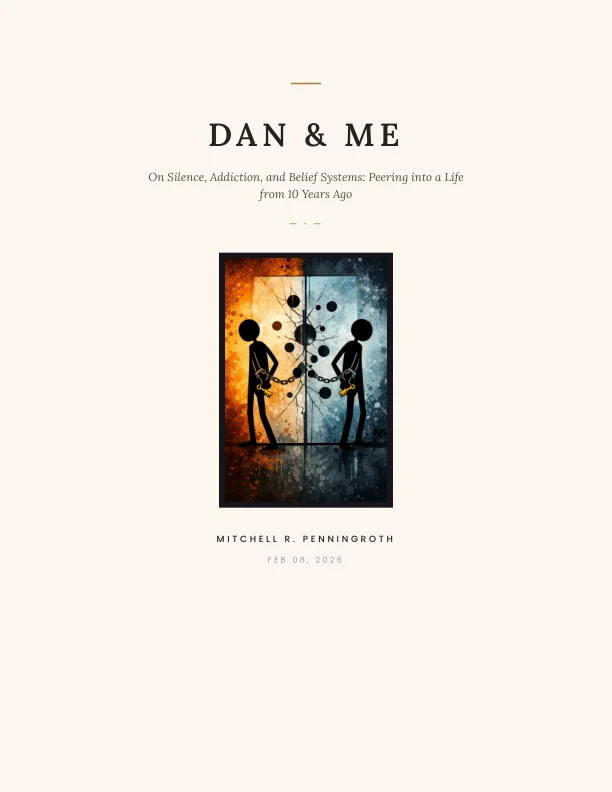
My addiction was my secret. Dan, my dorm neighbor, had a secret too. He was deeply depressed, to the point that ending his life felt like a solution to what, in hindsight, were probably temporary problems. We were only eighteen. I didn’t know he was deeply depressed.
One night, October 24, 2015, I came out of the dorm shower and realized I’d locked myself out of my room. Dan’s door was open, so he lent me some clothes while I waited. We chatted for awhile. He was his usual self: warm, funny, kind, humble. I eventually said goodnight and went to bed. I didn’t see him the next day.
Two days after that, a cop knocked on my door asking if I’d seen Dan in the last 24 hours. I hadn’t. I figured he or his roommate had gotten caught drinking or something and went on with my day.
That night, while eating dinner in the dining hall, I found out that Dan had taken his own life. They found him in a parking lot not far from our dorm. It seems like I cried a lot after that.
The day after that, there was a torrential downpour — the kind that feels like nature mirroring your internal weather. My normal concerns had dropped away, like background noise after putting on noise-cancelling headphones.
I kept replaying Dan and I’s last conversation in my head, realizing I was one of the last people to see him alive. How could I have missed that he was struggling that much? Were there signs? Did he ever hint at it? What if I had said this? Done that? And underneath all that, I knew I was secretly in a similar place myself unbeknownst to Dan and others — just hiding it differently.
A few months later, almost exactly 10 years ago now, in February 2016, as my addiction progressed and I felt increasingly trapped inside it, I made an attempt on my own life while drunk, high, upset, and hopeless at the age of 19. I nearly succeeded. I am lucky to be here. This happened, and was a secret I kept to myself for awhile. Another secret to keep. Every year
during early February, it’s hard not to reflect on this period of my life. That was then, and this is now.
Why was I so hopeless? Why did I feel so trapped? Because, as I saw it then, every available option led to some form of ruin. I couldn’t tell others that I had a drug problem. I was deeply ashamed, and I was also obtaining stimulants from friends unethically. If I asked for help that I didn’t think could actually help me, people would eventually realize I had taken their pills. That discovery wouldn’t just expose the addiction, it would also expose me as dishonest and untrustworthy. The addict stigma would be applied to me, and I was convinced my college social life, reputation, and future prospects would be permanently damaged.
But I also couldn’t keep using. Dosages were escalating. I wasn’t sleeping either. From August 2015 through November 2016 — about 400 days — I estimate that I went entirely sleepless on 100 nights or so, sometimes for multiple nights in a row. On the nights I slept, it was not restorative sleep to say the least.
It did give me a lot of time to think, a lot of time to read, a lot of time to read Wikipedia pages, a lot of time to scour Reddit, and I listened to a ton of podcasts walking around Iowa City late at night not knowing what else to do because I couldn’t sleep. I fell in love with podcasts. Sam Harris was the fucking man.
But not sleeping does a number on you. Coming down from high doses of stimulants with no sedative assistance is excruciating. Thinking becomes hard after enough sleep deprivation. After a stimulant binge, when you can finally sleep, other obligations — class, socializing, even basic self-care — become irrelevant compared to escaping the sleep-deprived comedown hell you’ve been in.
That party I was invited to? I haven’t slept in 36 hours, I cannot have people see me like this. A class presentation? I took too much, I’m shaky, I’m sweating, I can hardly form a coherent string of thoughts because I haven’t slept in so long, and my pupils are huge — I definitely can’t have people see me like this. I’ll take the zero.
The only option I could identify that would not “ruin me” was stopping on my own, quietly, without anyone finding out, so I wouldn’t have to pay the reputational consequences of being an addict. So, I tried to quit innumerable times. I tried to control it by making rules for myself. I tried to limit my use. I tried many strategies, repeatedly. I would tell people not to sell it to me anymore, for example. Every strategy failed. I literally could not stop. This was not something I could out-effort.
I couldn’t keep using, and I couldn’t stop. Both felt impossible. Active addiction is hell. I believed I had a uniquely unsolvable problem — one no one else could understand and that
only I could solve, alone and in secrecy — and yet I kept failing at solving it. In recovery, this is known as terminal uniqueness, and shattering the illusion that your addiction is singular and not understandable is vital to recovering. I’ve encountered few things scarier than having a catastrophic problem you believe is fundamentally unfixable.
So, I was caught between two impossibilities. I couldn’t ask for help without destroying the life I was trying to protect, and I couldn’t stop on my own no matter how hard I tried. There was no visible path forward. From inside that logic, hopelessness becomes a conclusion you settle for.
After my attempt in early 2016, I decided to stay the course a bit longer. I thought over summer break I could figure out how to stop — it only got worse. By fall 2016 I received what recovery circles call the “gift of desperation.” I could not keep using, something had to give. It was agony.
It led me to being willing to ask for and accept help almost exactly a year after Dan’s passing. I called my dad, asked him to come get me, explained to him that I had a drug problem and needed to drop out, and that was that — no going back once loved ones are aware of what’s going on. My dad thought I was doing well and I was about to start an internship at his firm — this was a hard conversation to have.
Still, I genuinely didn’t think I could be helped, but I was too scared to attempt again, and I didn’t know what else to do. I dropped out of school and checked into rehab in November 2016. Recovery was a whole new world to me, a new type of education. I spent a lot of time around other addicts, slowly realizing I wasn’t special or unique in my suffering as an addict. This was very relieving to discover. Whatever ways that I may be unique does not include the type of addict I am — how I think, how I crave, how I want to control how I feel. I’m a run of the mill addict.
I learned quickly that addiction doesn’t discriminate — it doesn’t care if you’re smart, rich, poor, white, not white, etc. It also works the same for any drug — a drug is a drug is a drug. The woman who drinks wine until incapacitated each night after work is remarkably similar to the meth addict with nowhere to call home.
In treatment and recovery circles, you get to know people fast. There’s no pretense. Everyone’s been shipwrecked, and it feels a bit like I’d imagine survivors of the Titanic felt interacting with one another. A shared calamity that makes it easy to connect without reservation. Everyone gets it. I learned that beneath everything, we’re all just people — much more similar than different.
When I first got help, the opioid epidemic was making waves in the U.S. You’d make a friend, they’d relapse, and then they’d be gone — life snuffed out in an instant. It was weird how normal this became.
Years later, looking back, I see a pattern among those who made it out and stayed sober — deep honesty about the ongoings of their own minds, humility to continue asking for help, courage to keep trying, and some luck. Intelligence is not a differentiator in who recovers and who doesn’t as best I can tell.
Oftentimes when people with long-term sobriety discuss how they did it, they remark that recovery happened to them somehow, alluding to the same inability to solve the problem themselves that I encountered. This has been my experience as well, recovery has happened to me rather than I made recovery happen. It feels like I’ve escaped something that was inescapable, and it feels a bit mystifying as to how I escaped if I’m being honest.
All of this has given me perspective on how fragile life and health really are, how important it is not to leave things unsaid, and how essential it is to live courageously along your own path, not someone else’s. Being healthy tomorrow isn’t guaranteed. Being here in a year isn’t guaranteed. So, you do the most you can with the time you have.
Regarding Dan, if only one of us had known what the other was going through, maybe we could have helped each other hold on a little longer — long enough to find Dan a life raft out of those waters. Who knows? I don’t blame myself, but I still wish I had led more with my own vulnerability, in hopes Dan might have felt comfortable enough to do the same. This piece, in a way, is me attempting to practice leading with my own vulnerability. I’ve learned I can live with missteps, but not easily with the regret of silence or not having had the courage to try things that require confronting fear or risk — chances not taken are made choices too.
— · —