From the print edition · Original text and illustrations
Note: This will be a multi-part story.
I haven’t been eating many carbohydrates. This is the story of how that happened, and why.
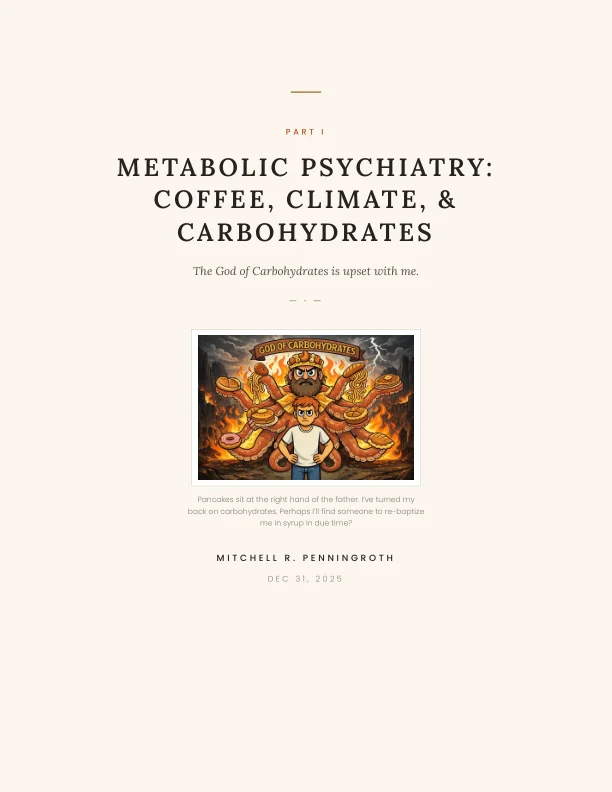
This was not the plan. On Wednesdays, she wore pink. On Fridays, Gimme S’more! was tried and true. Carbohydrates weren’t just fuel — they were a daily sacrament. And so, if a God of Carbohydrates exists, and demands worship at an altar of (CH2O)n’s, I regret to inform them that I have sinned.
I didn’t start cutting out carbs for myself, but I’ve continued for myself, and have been learning a lot about a question psychiatry has been unable to answer determinatively: What, exactly, is broken in mental illness?
A Fall Coffee
In October 2025, I got coffee with an entrepreneur in Austin, TX. He’s a health tech guy. Early 30s I’d guess. At age 21, he became fixated on the question of, essentially, if you look at a picture of people on the beach in the 1960s, why do they look so much healthier than if you were to look today?

He and I met on a sunny morning. Freshly shaven, button-up shirts, my own mild anxiety — I was lucky to get a piece of this guy’s time, and still somehow missed footing the bill.
This was, by any conventional standard, an important networking coffee for me. I needed a job. I should have arrived with a polished elevator pitch or some rehearsed version of myself. “Fail to prepare, prepare to fail,” as I was often told growing up.
I hadn’t prepared — sorry, Dad. Instead of collapsing into wasted opportunity, the conversation did something better: it stayed open. We talked. Niceties were exchanged, the opening salvos fired, and my background began to unroll. Not as a rehearsed pitch, but as a living thread shaped by his questions and the paths they pulled us down. Had I arrived with a polished script, I suspect we would have stayed safely within it. Instead, we wandered — far enough, unexpectedly, to stumble into an idea I didn’t yet know that would change how I understood my own mind: metabolic psychiatry.
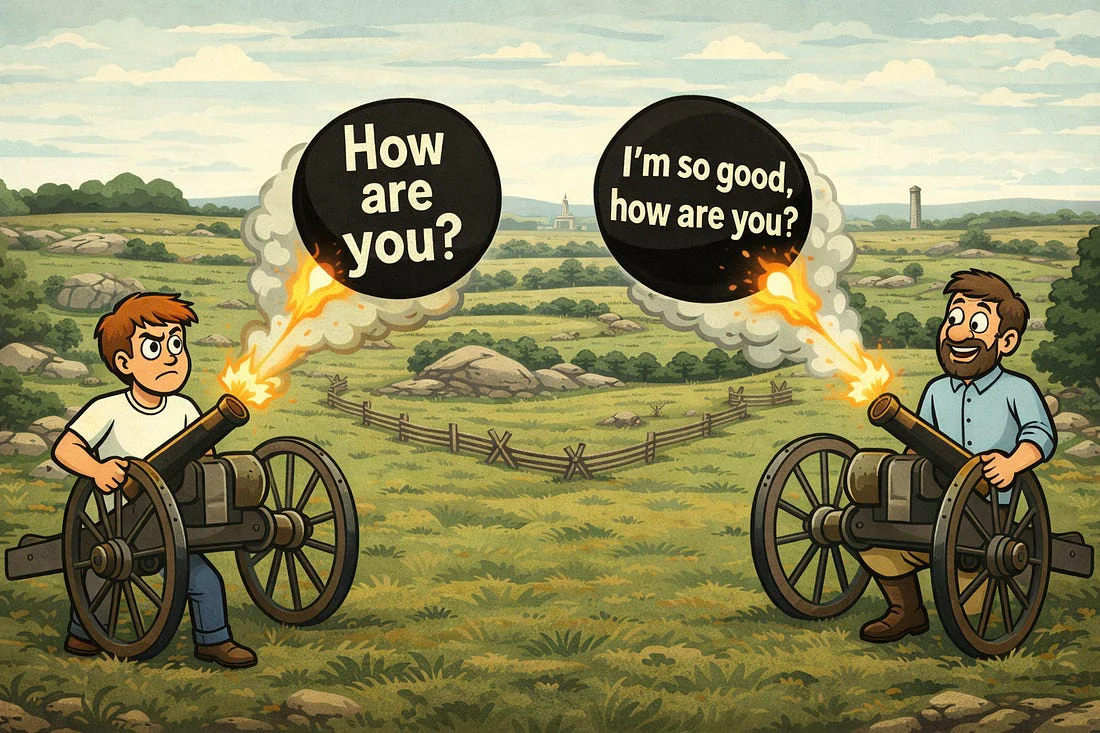
At one point in our conversation, I started relaying a spiel about how we’re still in the stone age when it comes to understanding the neurobiology of mental health issues. In mental health, we can describe what’s going wrong, but we still don’t know what’s broken in an objective, tangible sense.
Our diagnostic categories are built primarily around symptoms: what a person reports, what clinicians observe, and how those patterns tend to cluster. That approach is practical, and sometimes useful — but it is not the same thing as a biological explanation.
By analogy, it’s as if we can describe the weather. We can note wind speed (anxiety), cloud formations (depression), precipitation (self-harm). We can even cluster certain patterns and give them names — a tornado (OCD), a hurricane (Bipolar), a drought (ADHD). But naming the storm doesn’t tell us why the weather is behaving the way it is.
Has the atmospheric pressure changed rapidly?
Is the landscape receiving more sunlight than before?
Is an El Niño event occurring?
We can classify the storm, but we don't understand the climate. What’s driving the storm? For most (if not all) mental illnesses, we still cannot point to specific cellular processes that are broken in a specific way and say, this is the cause. What we have instead are symptom-based buckets that often overlap, blur, and change over time. These buckets reflect zoomed-out observations that are far less reliable than the underlying biology that I’d wager likely exists, but remains largely undiscovered. And this line of thinking isn’t unique to me. As Thomas Insel, former director of the National Institute of Mental Health (NIMH), put it:
“So far, we don’t have rigorously tested, reproducible, clinically actionable bio-markers for any psychiatric disorder.”
T H O M A S I N S E L
This applies (at least) for the following conditions:
— ADHD — Major depressive disorder — Anxiety disorders — Narcissistic personality disorder — Antisocial personality disorder — OCD — Autism spectrum disorder* — PTSD (shoutout CPTSD too, I believe in you) — Bipolar disorder — Schizoaffective disorder — Borderline personality disorder — Schizophrenia — Histrionic personality disorder
hole). It also suggests that while symptoms vary wildly for different disorders, the underlying root causes may be remarkably similar. All roads may lead to Rome: particular types of cellular and molecular dysfunction.**
By comparison, if someone has a heart attack, we see the storm (chest pain, shortness of breath, cold sweats), and we can pinpoint the exact artery that is blocked, the exact cells that are dying from lack of oxygen, and as a result, the elevated troponins in the blood, so of course a storm happened. The storm makes sense because the climate is understood. We can trace the symptoms downward to mechanism.
Mental illness does not afford us that kind of clarity. We see the symptoms, we name the storm, but we’re still largely blind to the equivalent of the blocked artery, the dying cells, the molecular signal in the blood.
After my spiel, he suggested that I read Brain Energy by Chris Palmer. I told him I would. What I didn’t realize at the time was that a conversation over coffee would become the entry point into an entirely different way of thinking about mental health — one that would lead me to cut out carbohydrates, not as an experiment in discipline, but as a way to explore the connection between mental health and metabolism for myself, and to try to help someone else.
E D I T O R I A L N O T E S & A D D E N D U M S
* I took a neuroscience class where we spent considerable time studying autism spectrum disorder. The professor teaching the course (a prominent researcher in the field) began our exploration of autism by telling us that, as of 2023, it had become increasingly unclear what autism even is, and that there is no generally agreed-upon understanding among those who study it.
** Substack doesn’t allow me to caption videos in the same format as images, apologies for the formatting.