From the print edition · Original text and illustrations
A N O T E B E F O R E R E A D I N G
I wrote this during a PTSD episode.
I encountered the close-up footage of the assassination by accident, and it set off a stretch I recognize: hypervigilance, difficulty disengaging once my nervous system has flagged something as a threat, and the compulsion to resolve what cannot be resolved by thinking harder at it. Writing is what I do in that state. It is also a state that runs hot — it can mistake urgency for importance, and make every open question feel like it has to be closed immediately.
I am noting it for two reasons. It is part of why my reaction was as strong as it was, which I describe in the piece without explaining. And naming it is a check on it: I revised this many times, letting time pass between revisions to see what still held. Most of it did. What didn’t, I cut.
The argument should stand or fall on its own. But you should know the conditions it was written under.
Preface
I’ve revised this piece multiple times as I’ve learned more — the ability to change one’s mind in light of new evidence matters to me. I am not writing to please a side, I am writing to wrestle with truth in public. If I am unwilling to change my mind, how can I expect others to?
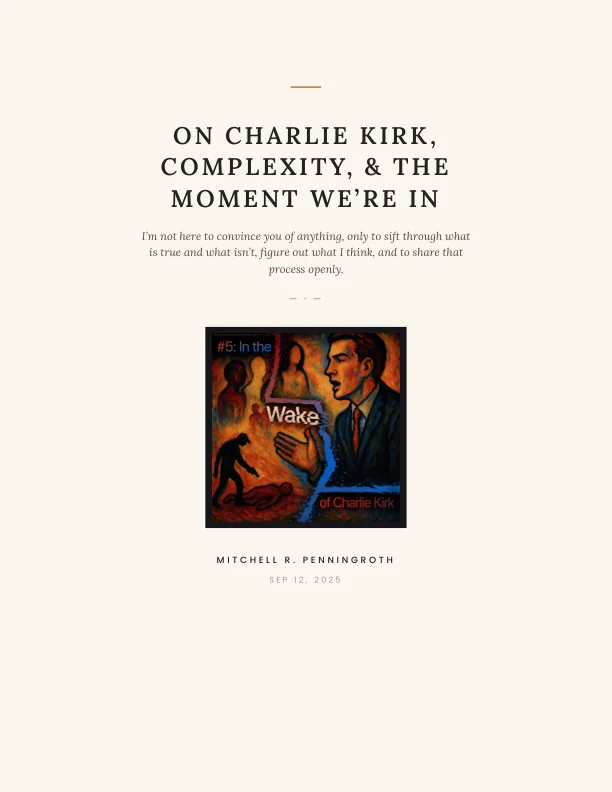
The cover of this edition is the artwork for an impromptu spoken rendition of some of these thoughts — off-the-cuff, using no notes, recorded in a single take. Note, I called Charlie Kirk racist in my podcast, and have since changed my mind.
If you’re unfamiliar with Charlie Kirk, the videos I drew on are listed in my Editorial Notes (at the bottom), and I’d suggest seeking them out — both the Charlie Kirk content and the “distortion” clips that show how algorithmic echo chambers and bad-faith commentary can warp a person’s image. There’s other information there too that helped me write this. I tried to get a wide range of perspectives both in the content I absorbed and from people within my life with different views. If there’s something you think I’m missing, please let me know.
From the outset of writing this, I tried to apply the principle of charity to Charlie Kirk and discard any preconceived notions — to begin with the most generous, good-faith interpretation before moving toward harsher judgments with more information. That, I believe, is the only responsible way to approach strong claims against anyone, especially when those claims are negative.
I have tried to ask myself, am I being completely fair and responsible in how I’m characterizing people that don’t agree with me politically? Writing this piece has been a balancing act, and
challenging, to say the least. I’ve asked myself — how do I write this in a way that doesn’t further divide us, that doesn’t endorse bigotry, that doesn’t celebrate violence, that doesn’t mischaracterize, and that humanizes all?
Along the way, I’ve discovered that it’s one thing to observe the “information war” from afar, and another to try being a responsibly edible part of the information ecosystem. Sorting truth from distortion in American politics right now without error is impossible — some of this comes from the right, some from the left, and some from other countries trying to tear us apart from within, undoubtedly.
We live in a moment where people are judged not only for what they say, but for whether they said it at the “right” time, in the “right” way, about the “right” event — and whether they’ve performed “correctly” in all their prior expressions. That mindset is corrosive. It reduces human grief to a scoreboard and public speech to a performance test. Play the right part — or else. The possibility of genuine connection and dialogue between people who think differently is reduced, walling us off from one another under the false truth that the world can be split between “good” and “bad” people.
Zoomed In
After accidentally encountering the close-up video of Charlie Kirk’s assassination on September 10, 2025, while sitting in my car in a parking lot, I found it difficult to think about anything else. I sat there for nearly an hour, stunned and horrified — I felt genuinely sick. The intensity of my reaction, especially since it’s not as though I’ve never seen disturbing content before, surprised me.
For nearly a decade, I had assumed Charlie Kirk was essentially a caricatured villain — a Nazi, fascist, white supremacist type. I wrote him off as so extreme on the far right that nothing he said could be worth my attention. From 2015 through 2019 or so, I was positioned comfortably on the left, and, in hindsight, fairly “woke.” I never once engaged directly with Kirk’s material. I only absorbed, passively, what others said about him. It wasn’t until after his assassination, when I actually explored much of his content for myself, that I realized how many of my preconceived notions had been wrong. My preconceived notions of Charlie Kirk feel like a box I had forgotten to move or re-open from my old house.
Here’s a Charlie Kirk quote: “I think race is completely and totally irrelevant……Race means nothing. I care about your actions, your character, and most importantly, your soul.”
And here’s another Charlie Kirk quote: “Happening all the time in urban America, prowling Blacks go around for fun to go target white people, that’s a fact. It’s happening more and more.”
And here’s one more Charlie Kirk quote: ““You will never be the best version of yourself if you allow other people to convince you that you can’t be better because of your skin color, because of your sexual identity, because of the community you came from — you must resist those narratives at all cost if you truly want to be successful in America.”
Charlie Kirk founded Turning Point USA in 2012 to counter what he saw as the overwhelming liberal tilt of higher education and to share his Christian faith. He traveled to campuses across the country, hosting events where he shared his views and invited attendees to challenge him in what was essentially an open-mic format. Whether you admire or despise that mission, he was, in many eyes, the closest thing to a living embodiment of the First Amendment in these times. He was also undeniably successful at giving young voters access to perspectives they might not otherwise encounter — unrivaled by anyone on the left, which assuredly plays into the amount of hate he received. Young voting moved by something like 9 percentage points towards Republicans in the 2024 election, and Kirk was instrumental in that shift.
It was eye-opening to realize how popular Kirk had become and the scale of his influence on the broader Trump phenomenon and the remaking of the Republican Party over the last decade. I had no idea how significant his impact was. Trump himself — perhaps the most self- crediting person I know of — even told Kirk he was “one of the three or four most responsible people for my [his] re-election.”
I disagree with many of Charlie Kirk’s positions — from insisting the 2020 election was stolen, to denying climate change, to casting doubt on vaccines. He also endorsed a candidate who, at best, failed to prevent the violence of January 6, 2021, and who was later found liable for sexual abuse in civil court.17 What is difficult to reconcile is how Kirk’s Christian faith — which calls for truth, humility, and protection of the vulnerable — could coexist with support for Donald Trump. To me, his endorsement speaks less about Kirk’s personal character than about the poverty of options in American politics. Still, there is no shortage of places where Kirk and I part ways.
And yet, if he truly embodied several of the terrible labels I had assumed of him, I haven’t seen convincing evidence. If I’m going to call someone a Nazi, for example, I should be absolutely certain. After all, after the fall of Nazi Germany, much of humanity agreed their crimes were so universally evil that death sentences were justified — has that moral standard changed?
Labels like “Nazi” or “racist” become hard to apply when I’ve now watched Kirk say he wished for a colorblind society, where a person’s value is independent of skin color, and that he believes all people are inherently equal, along with a different video of him visibly upset with a white man who was spewing genuine racism along the lines of only white people belonging in America.
People must be able to speak their minds freely without fear of losing their lives for it. If I’ve got a view and you’ve got a view, the answer is dialogue — discovering that we’re often not as different as we might think, and that both of us may be good people with good intentions. If you can’t find common ground and dislike how someone else is convincing others of their views, the answer is to make a more compelling argument — nothing else.
Still, Charlie Kirk’s assassination does not mean we should remake him into someone he wasn’t. I’m not denying that he was bigoted and ignorant in various ways, and he said some entirely careless things that were harmful. He was sexist in how he viewed women’s roles in the world, and discriminatory in his skepticism toward the professional competence and safety of non-white Americans. His racial discrimination, as best I can tell, was not rooted in a belief that others were inherently lesser, but in his opposition to certain affirmative action ideologies — frameworks that, in his view, encouraged people to see the world through categories of race and sex. I haven’t worked through every label, and the others are no less important. The point is, he was caricatured in ways that were dehumanizing and inaccurate — nuance was lost. Again, to reiterate, if I am somehow wrong here, show me how.
It’s worth noting — discrimination cuts in more than one direction. For example, it is prejudiced to assume that white men are inherently out to oppress others and to view the world through that lens — an encouraged “virtuous” perspective frequently encountered on U.S. college campuses. Likewise, it is sexist to say things like, “I hate men.” or “Men shouldn’t exist.” Even joking, imagine men casually saying the same about women, and the effects that might have if continually repeated and normalized.
The irony is that these examples are often framed as progressive, yet they recycle the very logic of bias they claim to oppose — reducing people to group identity and pre-judging worth or intent before knowing them as individuals. There is never a good reason to assume you know someone’s value, intentions, or beliefs without actually knowing them — whether they are white, Latino, Black, male, female, or trans, etc. The point is simple: take each person as they are — don’t assume.
Far from dismantling discrimination, these “progressive” ideas revive it under a new banner. You don’t extinguish a fire by adding more fire. If I were to discriminate against others, how could I reasonably expect them not to do the same in return? And why, as a white man, would I support a party that spent years telling me to be ashamed of traits I never chose — even bringing that message into classrooms I sat in repeatedly — except out of sheer opposition to the other side? Food for thought.
At the same time, history and power structures do matter. Supporting those who have been historically discriminated against and ensuring equal access to opportunity is not only
necessary but right. The challenge — the real work — is finding ways to do this that heal divisions rather than deepen them.
On women, I watched Kirk speak unequivocally about their value and how much he respected what they bring to the world. At the same time, he endorsed rigid ideas about how their lives should look, even while sincerely expressing that men and women are equals. For the record, I believe women should live their lives however they choose to, and I also disagree with Kirk’s pro-life absolutist stance.
Another example, it is often claimed that Kirk supported violence against homosexuals based on comments he made to Ms. Rachel, a popular YouTuber, in 2023. In that exchange, he noted that some people cite Leviticus 19’s “love your neighbor as yourself” while ignoring nearby passages such as Leviticus 18, which condemns same-sex relations as an “abomination” and encourages stoning such individuals. Commentators stripped away that framing and reduced it to “Kirk advocated stoning gays.” His actual point was that selectively quoting scripture is dishonest — a critique I’ve also heard from the left when calling out religious hypocrisy. (See the Stephen King public apology in my Reads section below on this very distortion.) For the record, I support people’s right to live their lives freely, including homosexuals.
Many videos I watched showed restraint, sincerity, kindness, and a genuine commitment to measured discourse with people who disagreed with him. He rarely raised his voice. That is exactly how politics should be done. On campuses, he was sometimes proven wrong, and he seemed willing to accept it when it happened — a humility not often seen. Professors, citizens who are overwhelmingly liberal, share their ideologies with their students — is it inherently wrong for someone to do the same as a non-Democrat?
Kirk practiced an incredibly rare form of courage — he went directly into hostile environments and publicly engaged people face-to-face. That is commendable — many of us have strong views, and yet we do nothing with them except share them privately. Another interesting note — when Charlie Kirk founded Turning Point USA, his aim was to have others share their views on college campuses, not him. He ended up doing it because he couldn’t find anyone better than him at it. The fact that he held open conversations on college campuses was a good thing.
That point isn’t mine alone — I listened to Senator Mark Kelly of Arizona and Senator Bernie Sanders of Vermont, who share almost none of Kirk’s views, express as much in their remarks. Ezra Klein also shared this sentiment. Gavin Newsom shared this sentiment. They also made remarks to the effect that Kirk was intelligent. Representative Alexandria Ocasio-Cortez cancelled her weekend events out of respect for Kirk. If any of this is surprising, you might be in an echo chamber.
His assassination will inevitably create a chilling effect, discouraging others from coming to campuses or other places to share their views — which is a deeply troubling outcome. Higher education, in particular, should be one of the safest and most essential spaces for genuine viewpoint diversity. Campuses should be intellectually dangerous, and physically safe. Campuses should teach people how to think, not what to think.
Kirk had a three-year-old and a one-year-old — it is easy to forget the humanity of all of this, and it was difficult watching a video of him playing with his daughter. People who knew Charlie Kirk personally described him as “warm and gregarious.” His wife says that in all her time of knowing him, he never once raised his voice at her, and never once was mean-spirited to her either.
Further, to be objective, it’s worth recognizing that when someone speaks openly, given enough time and material, it is always possible to pull a quote or action out of context to make them look bad. Intent and full context matter. If any of us had every difficult conversation we’ve had since age eighteen recorded and replayed, it’s unlikely we would come out entirely unblemished.
What is also clear is that Charlie Kirk was nonviolent. To equate speech with violence — another false truth that has gained alarming traction on college campuses — is to collapse two categories that must remain distinct. In a recent multi-campus survey, one in three U.S. college students agreed that violence was an acceptable way to respond to speech they disagreed with.12 Really, pause and think about that.
Words can certainly wound, or even incite harm, but they do so in ways categorically different from a punch or a knife. If we blur that line, we risk treating actual violence as merely another form of “speech,” protected by the First Amendment — at which point the foundation of civil society becomes lost.
I hesitate to dwell too long on campus ideologies, but my concern cannot be overstated. The patterns and beliefs I witnessed firsthand are not abstract culture-war talking points. They are real, they are toxic, and they will have grave consequences for our society — this is the type of thing that happens when you teach a generation that disagreement = harm. In 2024, a senior non-white female administrator at Brown University told me, “I feel no worse for anyone on this campus than white men. The things that happen to them here…” Other administrators later explained to me that she had an outstanding reputation, and that she was known as something of a “loose cannon” for speaking truths others avoided, even when they were inconvenient.
What unsettles me most is that many people outside the campus environment won’t see it until the damage has already spread, and the people within campuses that can see it are
generally unwilling to speak up for fear of suffering consequences. I didn’t give it sufficient weight myself until I encountered it directly. Bill Maher’s comments (see below) align exactly with my own experience — if you don’t simply tow the line with the left, they will not talk to you. There is no room for disagreement.
Back to Kirk. He died for the nonviolent expression of his beliefs. He was resolute in keeping the Second Amendment largely absolute, despite recurring mass shootings, thinking it was a net-win tradeoff against the prospect of a tyrannical government.
In 2023, at an event of his, he stated: “Now, we must also be real. We must be honest with the population. Having an armed citizenry comes with a price, and that is part of liberty. Driving comes with a price. 50,000, 50,000, 50,000 people die on the road every year. That's a price. You get rid of driving, you'd have 50,000 less auto fatalities. But we have decided that the benefit of driving — speed, accessibility, mobility, having products, services — is worth the cost of 50,000 people dying on the road. So we need to be very clear that you're not going to get gun deaths to zero. It will not happen. You could significantly reduce them through having more fathers in the home, by having more armed guards in front of schools. We should have a honest and clear reductionist view of gun violence, but we should not have a utopian one. You will never live in a society when you have an armed citizenry and you won't have a single gun death. That is nonsense. It's drivel. But I am, I, I — I think it's worth it. I think it's worth to have a cost of, unfortunately, some gun deaths every single year so that we can have the Second Amendment to protect our other God-given rights. That is a prudent deal. It is rational.”
There is tragic irony in that statement. He also said something to the effect of why hasn’t Paul Pelosi’s 2022 attacker been bailed out yet — a comment, when stated, that suggested political violence could be acceptable, which I strongly condemn. It was a harmful thing to say. Kirk agreed, and after he said this and received pushback, he made clear that he did not support the violence against Paul Pelosi.15
None of this, however, justifies his assassination. There is nothing funny or deserved about a wife and two young children watching their husband and father brutally assassinated in front of them — and that the entire world saw it too, instantly, in unavoidable clarity. This should not be controversial. A sick individual’s bullet took from us a rising conservative and a worthy challenger of the left.
As for those who might protest my unpublished thoughts on the assassination of Democrat Melissa Hortman and her husband, or on the school shooting that occurred the very same day as Charlie Kirk’s assassination — part of the reason Kirk’s death has received such an outsized response is that we were made to confront it viscerally. The footage forced the public to sit with its raw brutality in a way other tragedies are often shielded from us. To be clear, I don’t believe we should need graphic imagery in order to take loss seriously. But, it seems, visibility shapes reaction, and should we really be gatekeeping tragedy? Is that helpful? For example — if you posted about George Floyd in 2020, did you also post about Tony Timpa in 2016? (If you’re unfamiliar with Tony Timpa, see the video below and my Reads section.)
What makes Charlie Kirk’s killing especially hard to stomach is that he wasn’t a public official, he wasn’t in formal power, and he had no authority over policy. Being a public official is known to come with risk unfortunately — for example, one out of three presidents in the last 50 years have been shot at. Charlie Kirk was, quite literally, just a dude speaking on college campuses. Whether the victims of violence are adults voicing their views nonviolently or children, it’s all tragic.
Let’s go back to severe labels. This problem isn’t limited to one side of the political spectrum — both left and right indulge in it. On the right, I’ve seen Democrats described as “Marxists” and political opponents accused of being “groomers” or “traitors.” Not a label, but Trump recently accused Obama of treason — a crime punishable by death.13 14 The fact that isn’t news we’re discussing speaks volumes. When extreme language is used carelessly, three things happen: it loses precision, individuals are dehumanized, and some people will take it literally, creating moral permission structures for violence.
Young men overwhelmingly commit this type of violence, and we are also facing a crisis of them withdrawing from society — an existence where the guardrails that typically prevent radicalization and the literal embrace of dangerous rhetoric are no longer as present as they should be.
Case in point. Tyler Robinson, one of many young men who have withdrawn from society and retreated into a digital existence, texted before assassinating Charlie Kirk, “Some hatred cannot be negotiated with,” expressing the logic that once someone is defined as irredeemably evil — say, a “Nazi” or a “fascist,” for example — violence becomes thinkable, even necessary.
His words don’t prove that every careless label leads to bloodshed, but they illustrate the danger. That is why labels of bigotry must be applied with the utmost care. They should
function like social Geiger counters — sensitive, precise, and well-calibrated, with genuine hits being rare and all the more serious when they occur.
What should we do when we hear the casual use of severe labels? In my view, they should be met with something that interrupts the flow of ordinary conversation. A gentle but firm pause. Something along the lines of: That’s a really serious word — are you sure that’s the right one here? Not to score points or “win” an argument, but to remind the speaker of the weight carried by the words they’ve just used, and the gravity of accusing someone of such things. It’s less a rebuttal, and more of a wake-up call: Think carefully about what you’re saying, and the potential effects it carries. If someone wants to use such a term, and is able to justify it, I can get on board with that.
Relatedly, I visited the Pulse Nightclub memorial in 2018, and Sandy Hook just a few months ago. Both felt important to me to take a moment to witness, pay respect to the loss of life, and reflect. It was, notably, striking to see children playing on a playground at Sandy Hook more than a decade later, carefree in a place marked by such infamy.
Those kids are a testament that innocence can re-emerge in the shadow of horror. Our job, if anything, is to protect that possibility — in America, a hope that differences are handled with words, not bullets.
Zooming Out
American political violence is not unprecedented. History is full of examples: JFK, Malcolm X, MLK, and RFK all within a five-year span, the attempts on Gerald Ford and Ronald Reagan, etc. In just the last two years, we’ve seen an assassination attempt on then-candidate Trump, another on Pennsylvania Governor Josh Shapiro, the assassination of a Minnesota legislator, and now the killing of one of the right’s most influential figures in the remaking of the Republican Party. A little further back we had January 6th, the plot to kidnap Governor Gretchen Whitmer, and the attempted assassination of Supreme Court Justice Brett Kavanaugh in 2022.
Violence of this sort tends to be mimetic. The rash of serial killers from the 1960s through the 1980s carried this quality, each case amplifying the next in the public imagination. And in more recent decades, school shootings have followed a similar pattern, Columbine becoming a grim template that others followed.
What is unprecedented is the speed and scale of how we now experience it. We live in an age where information travels instantly, where narratives are built in real time, and where context is often lost in the flood of competing viewpoints. With algorithms echoing what we want to
hear, a convincing case can be made for virtually anything, by anyone, and shared with anyone, at any time — all by selecting certain facts and ignoring others, from an infinite pool of information available on demand.
Layer on top of this the collapse of basic communal constructs — the Church, the Tavern, and other historical “Third Places” — with the effects of having a sitting president who refuses to uphold the status quo simply because it’s the norm and the result is, yes, a moment that feels deeply unprecedented. If a future presidential candidate runs vowing to work on reigning in the power of the executive for themselves and future presidents, that would be appealing to me.
How all this will play out, who knows? But history is full of patterns — perhaps the world is gearing up for a period of madness similar to how the 1930s felt. It was a decade where the global order wobbled. The Great Depression shattered economies, unemployment soared, authoritarian regimes rose in Germany, Italy, and Japan, and Stalin had consolidated power and eliminated adversaries relentlessly. To be fair, I’ve also got a limited viewpoint as a 28- year-old here.
I have often heard from others, “I knew things were going to be different” after 9/11 happened. Right now feels like that — that somehow a line has been crossed.
Difficult times may tempt us toward fear, rage, or retreat, yet they can also call forth incredible displays of courage and honesty. The 1930s remind us how fragile order can be. The postwar renewal that followed, and even the children playing at Sandy Hook, remind us that life insists on returning, and that peace and innocence can be found again.
The task now is to resist the easy pull of violence and cynicism, and instead choose the harder path — to keep trying to listen to one another and find common ground.
My perspective is that the far right and far left are loud minorities driven by charismatic forces and 40% of the S&P 500 being financially incentivized to stoke anger to keep us on their applications and “on sides”. Both extremes are blind to the fact that they share the same mindset — bigotry, hate, and a disregard for the rule of law and precedent that have made America, well, America — in the best way. The ends of the political spectrum loop onto one another — it feels analogous to two blind people standing back to back thinking that they’re shouting at one another from across the room.
By contrast, the majority center lacks both courage and compelling voices. Most of us are reasonable and well-intentioned, but we remain quiet. We need to raise our voices and find leaders who can bring people together — leaders we do not yet have.
The way forward is live discourse and a focus on our commonalities: love, not hate. Curiosity and the principle of charity, not contempt prior to investigation. Humanization of one another, not demonization.
Editorial Notes, Addendums, & Materials (and yo, we’ve got a lot)
*Charlie Kirk was entirely right about the lack of political viewpoint diversity in higher education.
**Death by firing squad can still be used as a method of execution for those on death row in 5 states (Idaho, Mississippi, Oklahoma, South Carolina, and Utah). It is generally a back-up option to more “humane” methods. It happens very rarely in recent history, although South Carolina used this method in March 2025.
*** I had AI proofread this piece, and I had dialogues to help illuminate avenues within my own thoughts. At times, edits were suggested, reviewed by me, and then either incorporated or not. I am still figuring out my exact relationship with AI in writing, but I believe an authentic human voice is essential. Writing matters because it communicates what people think and feel, not what machines generate on their own. It’s important that we hear from people.
**** This piece is about Charlie Kirk’s assassination. I do not condone how his assassination is and will be used to further other agendas, and it lies outside the scope of what I’m trying to convey here.
Distortion Videos
These were embedded as video in the original post. In this print edition they are listed with their source and a short note on what each shows.
Here is a great example of how quotes can be taken out of context. The “Very Fine People” Myth:
1. The Media’s “Very Fine People” Myth — PRAGERU Argues that press coverage misrepresented Trump’s August 2017 Charlottesville remarks by cutting the surrounding transcript. The claim is contested. It is included here as a worked example of how framing changes what a quotation appears to mean.
2. J.K. Rowling’s “transphobia,” as of 2024 Another example regarding JK Rowling’s Transphobia as of 2024 — a second case comparing what was said against how it was characterized.
3. Bernie Sanders’s Comments — SEN. BERNIE SANDERS, SEPT. 11, 2025 I thought Bernie Sanders’s remarks about Charlie Kirk’s assassination were excellent. Sanders opens by noting he disagreed with Kirk on almost every issue while calling him a smart and effective communicator and organizer, then frames political violence as “political cowardice” — the inability to persuade, so force is substituted.
4. JD Vance Comments — REAL AMERICA’S VOICE / THE CHARLIE KIRK SHOW Vance, introduced on-screen as a longtime friend of Kirk’s, speaking in the days after the killing.
5. Alexandria Ocasio-Cortez Comments — PRESS GAGGLE, SEPT. 2025 Ocasio-Cortez speaking to reporters after postponing her weekend events, on accepting a level of personal risk in public office and on congressional security protocols being designed “for a bygone time.”
6. Contrarian Bill Maher Comments Maher on the left’s intolerance for dissent within its own ranks. Cited in the text above as matching my own experience.
7. Tony Timpa — DALLAS POLICE BODY-CAMERA FOOTAGE, 2016 Timpa called 911 on himself, saying he was off his medication. Officers held him prone for roughly fourteen minutes while joking. He repeated that they were going to kill him, and died. The medical examiner ruled it a homicide. Referenced above as a death that drew little public attention compared with George Floyd’s.
Charlie Kirk Videos
Note, the video content may not be in its complete context. Particularly, watch the first two videos and notice how different of impressions they give.
1. “‘He hates the Civil Rights Act,’ they say” — SHORT-FORM CLIP A campus exchange on racial discrimination, captioned by whoever posted it. The first of the pair to compare.
2. “Charlie Kirk being racist for 2 minutes straight” — SHORT-FORM COMPILATION A supercut assembled by a critic. The second of the pair — same subject, opposite impression.
3. Reaction clip — @JOSH_HOWERTON Commentary paired with footage of a campus exchange.
4. Studio clip, captioned “America?” Kirk at his desk, from a broadcast segment.
5. Campus exchange — TIKTOK, @CHARLIEKIRKDEBATECLIPS An open-mic question from a student at a Turning Point event.
6. Surrounded: 1 Conservative vs 25 Liberal College Students — JUBILEE, SEPT. 2024 The debate format where Kirk sits encircled by twenty-five students who rotate in to challenge him under a timer. Roughly ninety minutes. Among the most-watched material he made.
7. “Are you done telling me your story?” — TURNING POINT USA CAMPUS EVENT A tense exchange at the table during a campus stop.
8. Campus exchange — TIKTOK, @VALHALLOUSE Another open-mic exchange from the same tour format.
9. “The black pilot comment from Charlie bothered me, so I did my research” — GOTHAM’S
GHETTO GOSPEL MORNING SHOW
A response video working through Kirk’s remark about Black pilots and what he said afterward about it.
Charlie Kirk Quotes
Note, quotes may not be in their complete context.
On race
I think race is completely and totally irrelevant……Race means nothing. I care about your actions, your character, and most importantly, your soul.
— At a Turning Point USA campus event, unknown date
If I see a Black pilot, I’m going to be like, boy, I hope he’s qualified.
— The Charlie Kirk Show, 23 January 2024
Of course I believe anybody of any skin color can become a qualified pilot. That has never been my contention. It’s bigoted to think otherwise…My point was that DEI invites unwholesome thinking, and I said in that clip, that’s not who I am.
— The Megyn Kelly Show, unknown date
If you’re a WNBA, pot-smoking, Black lesbian, do you get treated better than a United States marine?
— The Charlie Kirk Show, 8 December 2022
Happening all the time in urban America, prowling Blacks go around for fun to go target white people, that’s a fact. It’s happening more and more.
— The Charlie Kirk Show, 19 May 2023
If I’m dealing with somebody in customer service who’s a moronic Black woman, I wonder is she there because of her excellence, or is she there because of affirmative action?
— The Charlie Kirk Show, 3 January 2024
If we would have said that Joy Reid and Michelle Obama and Sheila Jackson Lee and Ketanji Brown Jackson were affirmative action picks, we would have been called racists. Now they’re coming out and they’re saying it for us … You do not have the brain processing power to otherwise be taken really seriously. You had to go steal a white person’s slot to go be taken somewhat seriously.
— The Charlie Kirk Show, 13 July 2023
On debate
We record all of it so that we put [it] on the internet so people can see these ideas collide. When people stop talking, that’s when you get violence. That’s when civil war happens, because you start to think the other side is so evil, and they lose their humanity.
— Kirk discussing his work in an undated clip that circulated on X after his killing.
Prove me wrong.
— Kirk’s challenge to students to publicly debate him during the tour of colleges he was on when he was assassinated.
On gender, feminism and reproductive rights
Reject feminism. Submit to your husband, Taylor. You’re not in charge.
— Discussing news of Taylor Swift and Travis Kelce’s engagement on The Charlie Kirk Show, 26 August 2025
The answer is yes, the baby would be delivered.
— Responding to a question about whether he would support his 10-year-old daughter aborting a pregnancy conceived because of rape on the debate show Surrounded, published on 8 September 2024
We need to have a Nuremberg-style trial for every gender-affirming clinic doctor. We need it immediately.
— The Charlie Kirk Show, 1 April 2024
On gun violence
Now, we must also be real. We must be honest with the population. Having an armed citizenry comes with a price, and that is part of liberty. Driving comes with a price. 50,000, 50,000, 50,000 people die on the road every year. That's a price. You get rid of driving, you'd have 50,000 less auto fatalities. But we have decided that the benefit of driving — speed, accessibility, mobility, having products, services — is worth the cost of 50,000 people dying on the road. So we need to be very clear that you're not going to get gun deaths to zero. It will not happen. You could significantly reduce them through having more fathers in the home, by having more armed guards in front of schools. We should have a honest and clear reductionist view of gun violence, but we should not have a utopian one. You will never live in a society when you have an armed citizenry and you won't have a single gun death. That is nonsense. It's drivel. But I am, I, I — I think it's worth it. I think it's worth to have a cost of, unfortunately, some gun deaths every single year so that we can have the Second Amendment to protect our other God-given rights. That is a prudent deal. It is rational.
— Event organized by TPUSA Faith, the religious arm of Kirk’s conservative group Turning Point USA, on 5 April 2023
On immigration
America was at its peak when we halted immigration for 40 years and we dropped our foreign-born percentage to its lowest level ever. We should be unafraid to do that.
— The Charlie Kirk Show, 22 August 2025
The American Democrat party hates this country. They wanna see it collapse. They love it when America becomes less white.
— The Charlie Kirk Show, 20 March 2024
The great replacement strategy, which is well under way every single day in our southern border, is a strategy to replace white rural America with something different.
— The Charlie Kirk Show, 1 March 2024
On Islam
America has freedom of religion, of course, but we should be frank: large dedicated Islamic areas are a threat to America.
— The Charlie Kirk Show, 30 April 2025
We’ve been warning about the rise of Islam on the show, to great amount of backlash. We don’t care, that’s what we do here. And we said that Islam is not compatible with western civilization.
— The Charlie Kirk Show, 24 June 2025
Islam is the sword the left is using to slit the throat of America.
— Charlie Kirk social media post, 8 September 2025
On religion
There is no separation of church and state. It’s a fabrication, it’s a fiction, it’s not in the constitution. It’s made up by secular humanists.
— The Charlie Kirk Show, 6 July 2022
Reads
1. Stephen King apologizes for distorting Charlie Kirk’s Leviticus quote: https://www.usatoday.com/story/
entertainment/celebrities/2025/09/12/stephen-king-charlie-kirk/86123212007/
2. Ezra Klein, well-known liberal, with a piece titled: “Charlie Kirk Was Practicing Politics the Right Way” https://www.nytimes.com/2025/09/11/opinion/charlie-kirk-assassination-fear-politics.html
3. Melissa Hortman and husband assassination: https://www.house.mn.gov/sessiondaily/Story/18843
4. 2022 Paul Pelosi Attack: https://en.wikipedia.org/wiki/Attack_on_Paul_Pelosi
5. Colorado High School Shooting on the same day as Charlie Kirk’s assassination: https://
www.nytimes.com/2025/09/11/us/colorado-high-school-shooter-identified.html
6. The Killing of Tony Timpa: https://en.wikipedia.org/wiki/Killing_of_Tony_Timpa
7. Charlie Kirk in his own words: ‘prowling Blacks’ and ‘the great replacement strategy’: https://
www.theguardian.com/us-news/2025/sep/11/charlie-kirk-quotes-beliefs
8. We Are Are Losing the Information War with Ourselves: https://substack.com/home/post/p-173543390
9. ‘I Was Wrong About Charlie Kirk’: Six Conservative Students on His Killing: https://www.nytimes.com/
2025/09/12/opinion/campus-conservatives-charlie-kirk.html
10. A historical martyr: https://en.m.wikipedia.org/wiki/Horst_Wessel
11. The Coddling of the American Mind by Greg Lukianoff and Jonathan Haidt
12. A recent study of FIRE concerning violence on campuses: https://www.thefire.org/news/student-
acceptance-violence-response-speech-hits-record-high
13. Trump accusing Obama of treason: https://www.cnn.com/2025/07/22/politics/trump-obama-treason-
accusation-analysis
14. Julius and Ethel Rosenberg: https://en.wikipedia.org/wiki/Julius_and_Ethel_Rosenberg
15. Charlie Kirk on Paul Pelosi 2022 attack: https://www.yahoo.com/news/articles/charlie-kirk-once-called-
patriot-180221252.html
16. Van Jones with many similar ideas of my article, as written here: https://www.cnn.com/2025/09/19/
politics/van-jones-charlie-kirk-message
17. Trump liable for sexual abuse: https://apnews.com/article/trump-rape-carroll-trial-
fe68259a4b98bb3947d42af9ec83d7db
18. Not sure what to make of this one — but very strange EXCLUSIVE: FBI Investigating Social Media Accounts That Appeared To Indicate Foreknowledge of Kirk Assassination — THE WASHINGTON FREE BEACON
Listens
1. Charlie Kirk Assassination Aftermath — NEW YORK MAGAZINE
2. Breaking: Charlie Kirk, 31, Assassinated — THE BEN SHAPIRO SHOW
3. The Aftermath of Charlie Kirk’s Killing — THE NEW YORK TIMES
4. Charlie Kirk’s Murder and the Rise of Political Violence — THE FREE PRESS
5. We Are Going to Have to Live Here With Each Other — NEW YORK TIMES OPINION
6. Kirk Suspect Motives, TikTok “Framework” Deal, and Tucker Carlson Plays Detective —
NEW YORK MAGAZINE