From the print edition · Original text and illustrations
Working at the boundary of knowledge is challenging — the boundary exists for a reason. Beyond it lies a vast, tangled unknown, with no guarantee it can even be grasped by the human mind. Evolution’s slow chisel has shaped us to fit the universe, not the universe to fit our understanding.
Take my experience with quantum mechanics, for example. By the time I reached it in my undergraduate studies, I had years of prerequisites behind me: algebra, trigonometry, introductory calculus, multivariable calculus, linear algebra, differential equations, thermodynamics, general chemistry, statistics, and general physics come to mind. Up to that point, my problem-solving intuition usually lined up with reality. If I reasoned carefully and knew my stuff, I’d land in the right place. But in quantum mechanics, wherever my intuition pointed, I was often wrong. I worked hard, stayed engaged, asked questions — effort wasn’t the problem. After one long explanation of how I thought a problem should go, my professor simply said: “You are entirely off base.” He was right.
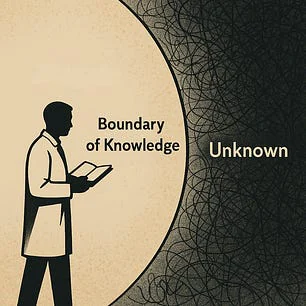
That became the pattern. The rules of the quantum world — and, interestingly, of the cosmic scale too — don’t map neatly onto how we experience daily life. On those edges, our ordinary compass often fails, though there are certainly individuals more capable and inclined to work with the “existentially weird” parts of the universe than I am. This is one aspect of why the boundary of knowledge exists. Not because we aren’t trying hard enough, but because reality itself, at times, resists our intuition.
There is also uncertainty in many things we think we know. Much of what we take as established is less secure than it appears. A single discovery can cascade through connected fields, reshaping theories the way a stone tossed in water disturbs every ring that spreads outward. What once seemed settled suddenly has to be re-examined.
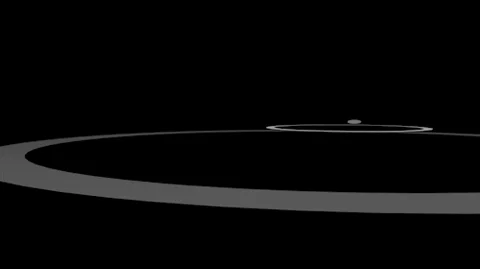
A modern echo of this lies in a case from the University of Minnesota, my alma mater. In 2006, neuroscientist Sylvain Lesné and his team published a highly influential Nature study pinpointing a compound called Aβ*56 as a primary cause of Alzheimer’s disease. It sent shockwaves through the field. Hundreds of millions in funding flowed to follow-up research.
But in 2022, sleuths uncovered that key “western blot” images in the paper were digitally manipulated — spliced, duplicated, even erased. For those unfamiliar, a western blot is basically a lab test that separates proteins and makes them visible on a film, like fingerprints on a crime scene, so scientists can see if a specific protein is present and how much of it there is. After a prolonged investigation across more than 20 papers, the original study was formally retracted in 2024, and Lesné resigned effective March 2025. Critics like Elisabeth Bik called the manipulation “a severe breach of scientific integrity,” warning that it had led other researchers astray and created “false hope” for patients and families. Many labs had been chasing shadows, as has often been the case as it concerns Alzheimer’s and amyloid beta (Aβ).
2
For a more historical example of the uncertainty of our knowledge, consider just a portion of Albert Einstein’s preposterous (still an understatement*) set of discoveries in the early 20th century. Before Einstein, Newton’s laws assumed that time and space were absolute — the universe a static backdrop. Think of this as a picture with fixed height and width, taking the same amount of time for anyone’s eyes to scan across.
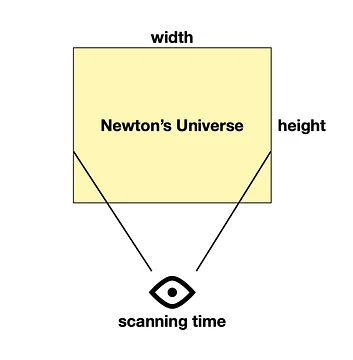
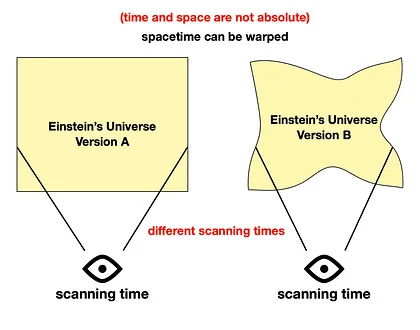
Instead, Einstein showed the picture is printed on a flexible sheet: stretch or tilt it, and the height and width change. Even the time it takes to scan depends on how the sheet is warped. Space and time aren’t rigid backdrops at all, but a single fabric — spacetime — bending and flexing with motion and gravity.
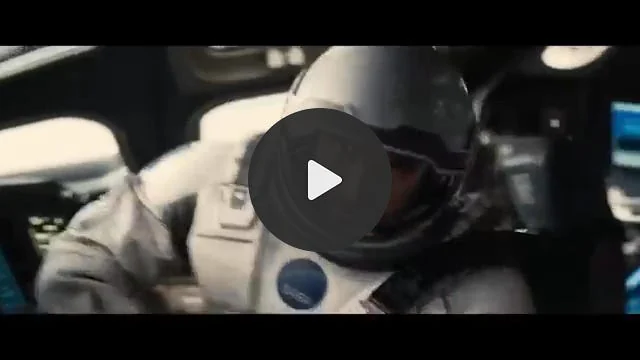
This brings to mind the Interstellar scene where the crew must escape the water world because of time dilation. To simplify: time dilation is the phenomenon in which time runs more slowly near a very massive object, like a black hole, than it does farther away.**
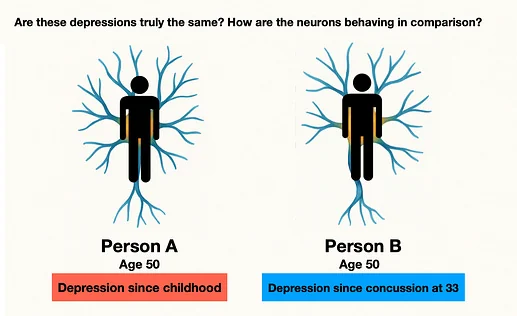
There are other factors that shape where the boundary of knowledge sits. For example, consider two people: Person A is 50 years old and has lived with depression since early childhood, while Person B is also 50 but developed depression after a concussion at age 30.
How might the neurons in Person A’s brain differ from those in Person B’s? Is their depression truly the same? Ethically, there are limits to how we can study this — entering a living person’s brain to collect, stain, or image neurons directly would compromise their ability to function. For now, the boundary of knowledge there is guarded, constrained by both ethics and the limits of current technology.
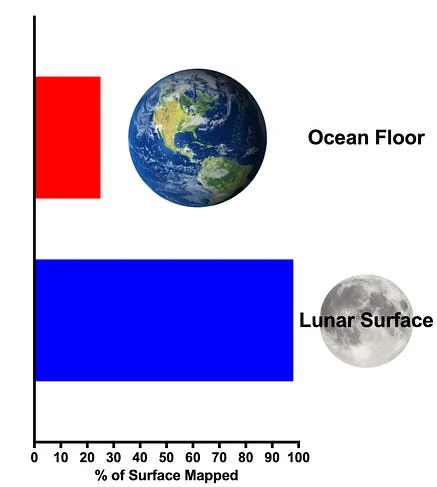
More broadly, this is to say the boundary isn’t set by nature alone — it’s also shaped by what we choose to prioritize. In the late 1950s, humanity decided it was of vital importance to reach the Moon, a goal that culminated on July 20, 1969, when Neil Armstrong stepped onto the lunar surface and declared, “That’s one small step for man, one giant leap for mankind.”
Today, at least 98% of the Moon’s surface has been mapped with high-resolution methods. By contrast, only about 25% of Earth’s ocean floor has been mapped to similar standards. Even more striking, at depths below 200 meters — where sunlight no longer penetrates — more than 99% of the seafloor remains entirely unexplored. If humanity in the late 1950s had decided it was of vital importance to thoroughly explore the ocean floor, do you think we would still have only 25% of it mapped well today?
My point is, the boundary is not arbitrary. The universe does not yield itself easily to our understanding, nor are we naturally equipped with the hardware to follow it everywhere without assistance (microscopes, telescopes, particle accelerators, etc.), along with the fact that we have appreciable agency in where we wish to push the boundary out further.
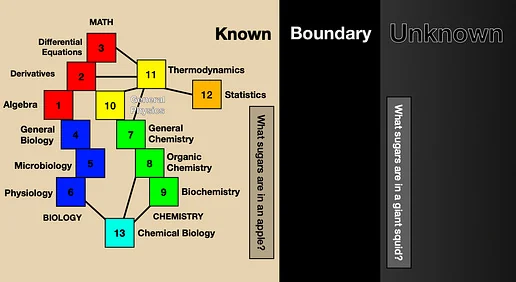
those blocks stack together in a way that allows us to press against the frontier of the unknown. The figure is only illustrative, no stock should be taken in how far any given block sits from the boundary. What lies within is safe knowledge, material that has already been tested and secured. On the far side of that boundary (right side) lie unanswered questions — the edge where research happens.
Pushing that boundary — the task of research scientists — usually entails countless failed experiments, long cycles of troubleshooting, and many hours of strained reconciliation between what we know, what remains uncertain, and how fragments of knowledge might be pieced together to reveal the next sliver of the unknown. And when such a sliver is finally captured, the work is not finished. New questions immediately arise about its limitations and uncertainties, and how its incorporation reshapes the boundary itself while reverberating back onto what was previously known.
Importantly, scientists rarely push into the dark blindly. Instead, they take a new question and anchor it to ones we already know how to answer. For example, asking, “What sugars are in a giant squid?” may sound unapproachable at first — but by linking it to established biochemical methods and knowledge of sugars in other organisms, such as an apple, the unknown becomes less opaque.
It’s like going to a new grocery store for the first time. How do you figure out where things are? You probably start by recalling how your old grocery store was laid out — fruits in one section, bread in another — and use that map as a guide while you explore the new one. Add up hundreds of thousands of years of venturing a little further into the unknown, and you get the arc from building a fire to splitting the atom.
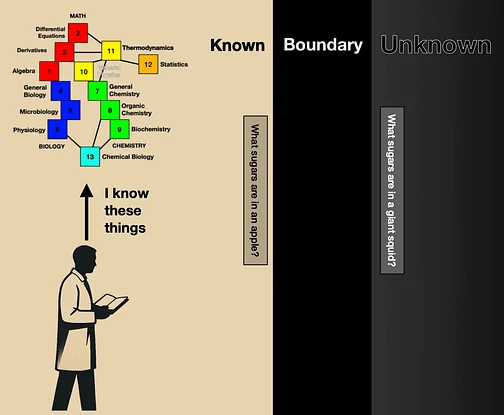
extend into uncharted territory and investigate an unknown question, such as the sugars in a giant squid.
Research is the act of standing on a scaffold, comparing what we do not yet know to something we already understand, and pulling a sliver of the unknown into the light of the known. Gaining slices of the unknown is generally hard-won. Specialists train for years to navigate the complexity at the boundary of knowledge as fluently as possible, but for most people outside a given niche, the technical language and fine- grained experiments are nearly impenetrable.
Within the life sciences — though this likely applies elsewhere as well — much of the work that shapes our understanding of life, and of ourselves, rarely reaches the broader public in a clear, meaningful, and timely way. Expertise that cannot be communicated is like a locked vault that endlessly refills itself. Impressive, sure, and useful if you hold the key, but far less valuable than it could be if its contents were made accessible to others. What say you, supply and demand?
If relativity showed us that even time and space bend under certain conditions, aging shows us something similar on a more personal scale. Our bodies, too, warp and change in ways that defy our everyday intuition and insight. Science has revealed much about this process, yet the
picture rarely travels far beyond the lab. We all recognize the obvious surface markers — wrinkles, gray hair, stiffening joints, fragile bones, slower reflexes, and eventually the failure of some crucial system.***
But beneath these familiar signs of aging lie hidden mechanics every bit as unforeseen as the physics behind a black hole.
If tissues change, then the cells making them up must be changing. And if cells change, then the molecules and structures within them — mitochondria, chromosomes, proteins, and so on — must also be changing.
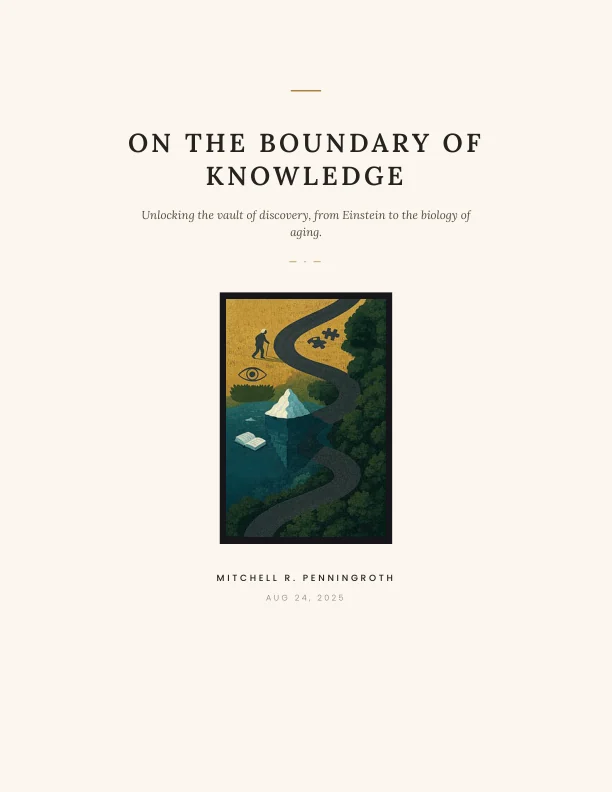
What we see is just the tip of an iceberg, with a finely pixelated mass hidden beneath. That hidden bulk is hard to measure directly or tease apart, yet it ultimately dictates the whole trajectory of aging. The full picture is still being assembled — aging is complex, multifaceted, and its precise definition can be slippery. Still, certain pieces of the puzzle are becoming clearer, along with hints of what we may be able to do with that knowledge. Personally, I think of aging as a health condition we all have in common.
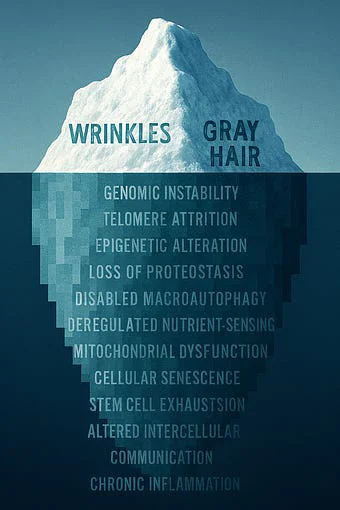
stiff joints — are just the tip of the iceberg. Beneath lie the 12 molecular and cellular hallmarks of aging identified so far: genomic instability, telomere attrition, epigenetic alterations, mitochondrial dysfunction, stem cell exhaustion, chronic inflammation, and more. While we’ve named these hallmarks, the full picture remains fuzzy, still coming into focus. Yet these hidden processes, though harder to see, ultimately shape the entire trajectory of aging.4
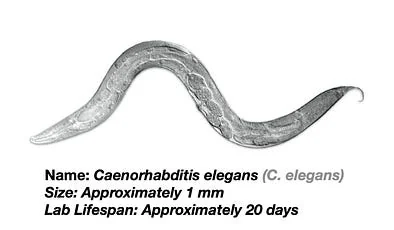
protein folding can literally be watched in real time. Despite its simplicity, many of its genes and pathways are shared with humans. Research in C. elegans has led to 4 Nobel Prizes as of 2024.
To give an example of “locked vault” knowledge: in C. elegans, a model organism in aging research, a brief heat shock early in life extends lifespan, whereas the same treatment later
has no effect.3 4 The stress activates heat shock proteins (HSPs), molecular repair systems that cells deploy to keep proteins from misfolding and chaos from spreading. What’s remarkable is that we can track this process fully: apply heat, measure the change of a molecular switch within the worm, track the surge of HSPs, and then observe the lifespan outcome. Stimulus in, measurable effect out — clear, objective, and tangible. There is no mystery, and that clarity is astonishing. By analogy, it’s like briefly exposing a new house to flame in order to fireproof it against future burns — but with an old house, the same treatment would not be helpful.
Maybe it’s just me, but health advice often feels fuzzy. To be clear, evidence-based providers are usually excellent at what they do — that’s not what I’m questioning here.
And yes, other forms of medicine can carry value as well.
I mean this more generally: you talk to one person in your life, then another, and then another, and the advice starts to clash. One says you should cut out carbs, another says carbs are fine but seed oils are the real problem, and another insists it’s all about intermittent fasting. The information gets murky. The promised outcomes are usually vague — you’ll “feel better,” “support wellness,” “fix your gut,” “align your energies” (What does that even mean? I’m encountering this a lot in Austin, TX.), “optimize health,” and so on.
Rarely do we get a perfectly clean chain to point to: do A, then B happens, which leads directly to C in an objective, fully deterministic way. Providers certainly work with cause and effect, but often at a different zoom level than research scientists.
Researchers isolate variables under controlled conditions to map out precise mechanisms in carefully defined slices of reality. Providers, by contrast, must translate that evidence into the care of a living, breathing human being — someone with multiple conditions, genetic quirks, personal beliefs, side effects, financial limits, and family stressors. In other words, providers operate within the messy, far less controlled, complexity of real life.
And then, in the research sphere, every once in a while we get worms in the vault — cases where cause and effect align with striking precision. The takeaway from the heat shock example is that sometimes stress preserves. This principle is called hormesis: low doses of a stressor or toxin trigger an adaptive response that ultimately makes the organism more resilient, both in general and to higher, potentially harmful doses of that same stressor.
Some stress, when experienced in the right dose and at the right time, is essential for building resilience. Aging research reveals this at the molecular level, where the picture is clearer and leaves less room for interpretation. Practices like exercise, fasting, or temperature stress are examples of hormesis in action, although our understanding of what exactly these practices do in humans at the molecular level remains incomplete.
My aim in future pieces is simple: outline, in plain language, what we currently understand about what it means to age at a zoom level usually inaccessible to outsiders. It won’t cover every detail, but it will provide a framework and can serve as a guide to exploring some of the components more in-depth if curious. An entry point into the biology of aging, of sorts. This approach will not be exclusive to aging long-term, but I thought I’d use it as a starting point.
E D I T O R I A L N O T E S , C O M M E N T S , & A D D E N D U M S
* If you haven’t read Walter Isaacson’s biography of Einstein, it’s absolutely remarkable how, seemingly out of nowhere, Einstein shocked the scientific community in the early 1900s. I first read this book about ten years ago, and I still find myself thinking back to that period of productivity with absolute amazement. Highly recommend.
** But motion can bend time too. The faster you move relative to someone else, the slower your clock will tick compared to theirs — an effect that only becomes noticeable at extremely high speeds, close to the speed of light. In Einstein’s universe, both gravity and speed can stretch or compress the flow of time.
*** As a good friend once said to me, “White people age like milk” — harsh, true, and heard.
**** I had AI proofread this piece for grammar and for scientific accuracy in terms of language. I do not want to provide “bad info” in my writing. Minor edits were suggested, reviewed by me, and then either incorporated or not. I am still figuring out my exact relationship with AI in writing, but I believe an authentic human voice is essential. After all, it seems unlikely that human sports will ever be replaced by robotic ones. The value lies in witnessing the distinctly human element, with all its imperfections. In the same way, writing matters because it communicates what people think and feel, not what machines generate on their own.
At the same time, refusing to use AI altogether seems unwise. It can serve as a tool. A way to check clarity, catch mistakes, or spark new ways of seeing, without replacing the human perspective at the heart of the work. In this piece, for instance, I also used AI to help generate some of the visuals.
If you would like more information about how I used AI here, please reach out to me.
***** See reference 4 regarding the 12 known hallmarks of aging, if curious.
S O U R C E S
1. Interstellar. Directed by Nolan, C.. Paramount Pictures: Los Angeles, CA, 2014.
2.
https://www.science.org/content/article/potential-fabrication-research-images-threatens-key-theory- alzheimers-disease
3. Lithgow et al. 1995. a. Link: https://drive.google.com/file/d/1OrCcaNTF8yaSGxOm73CqsybjqUVp3ZlZ/view?usp=sharing b. Takeaway: A single mild heat shock in early adult C. elegans extends lifespan, demonstrating hormesis through stress-induced resilience.
4. Ben-Zvi et al. 2009. a. Link: https://drive.google.com/file/d/1Fdddg1t6jG48WjKjJIBFt0VJmu6OBFUg/view?usp=sharing b. Takeaway: Proteostasis and the heat shock response collapse mid-life in C. elegans, explaining why heat-based hormesis is beneficial early but ineffective later.