From the print edition · Original text and illustrations
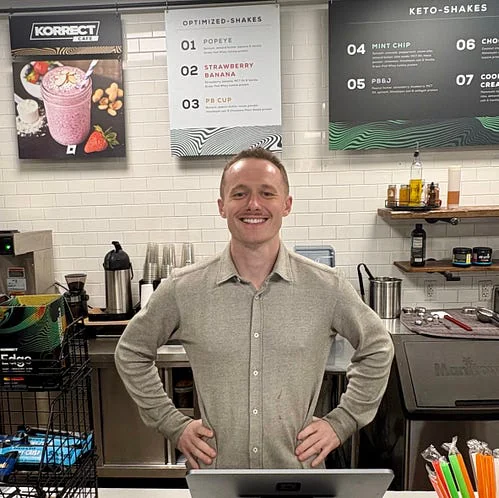
I used to work at a gym café in Texas making protein shakes for $15 an hour. The job was not glamorous. I did this for about three months as a PhD student at Brown University who had taken a leave of absence. Life was fucking weird — full stop.
At some point during that stretch, while working in the café, a guy walked in I didn’t recognize. Tall and built — the kind of physical presence that’s hard not to notice, though there’s no shortage of those at this particular gym. What caught my attention wasn’t what he looked like. It was what he did when he came to the counter for a protein shake.
He met me like I was someone worth meeting. He was
began that a customer (or several)
curious about me and my life in a way that was clearly
called in to let my manager know
sincere. No transactional politeness, no pretense, no “I’m
that they were not satisfied with their shake quality. As a chemist (a
above you” vibe. Tipped well. Then I saw him do the same
professional-grade mixer of liquids), I
thing with the next person. And the person after that.
found this juxtaposition worth noting. Good times!
I noticed this pattern whenever he came in over the course of several weeks. It didn’t seem like a one-off. It was just who he was. Big kind man. My read at the time: how he looked did not equate to how he operated in the world — he didn’t fit the way he’d typically be stereotyped.
And then I found out “who he was”.
Brad Womack is best known — probably exclusively known, if you’re not from Austin — for being The Bachelor twice. Helllllllloooooo, Bachelor Nation. I was not anticipating encountering you up close and personal — so it goes!
Here was a clear example of why assuming you know someone based on appearance or hearsay — and then fitting everything they do into that assumed picture — is a losing strategy. People surprise you when you’re open to discovering them (shocker.) People’s judgments of someone else are theirs and generally reflective of their own issues — not the person being judged.
What I’d discovered was someone who doesn’t need to be kind to people who can’t do anything for him, and yet was. Not nice — actually kind. Brad didn’t register as false. He also didn’t seem particularly into himself, common in a gym full of influencers.
I filed this and moved on. Left Texas, went back to the East Coast, fell apart out there, returned to Texas, and started sharing publicly about my sobriety. Somewhere during that
stretch, Brad and I followed each other on Instagram. As I continued to publicly share, he would occasionally like a post or send a word of encouragement. Small things, but not nothing.
As I kept writing and podcasting, Brad kept coming to mind as someone I wanted to talk to. Not about The Bachelor, but about what it did to him internally. How did this period, of intense public attention, if we view that as a stressor, internally remodel Brad? What was it like to be hated by people that didn’t actually know you? This is what primarily interested me, along with his kindness.
I also wanted to explore what being an identical twin has done to his life. Can you imagine if you were a twin, and your twin was The Bachelor or The Bachelorette? What would that be like, and vice versa?
In most public accounts of Brad Womack, his twin brother Chad appears almost exclusively as co-founder of their business. The twinhood gets treated as a biographical footnote — yet as a twin myself, I understand how being a twin is woven into the most core fabric of how you understand yourself.
I wanted to examine how being part of an identical pair has shaped Brad’s psychological architecture — what is his sense of a separate self, what is his internal answer to the question of who am I, specifically, as distinct from the other person who shares my face and so much of my history?
Because I’m a twin, my hope was to investigate this as a peer. There’s a category of conversation that only opens when the person asking has actually lived a version of what’s being asked about. Realizing that the person across from you gets it is powerful.
When he agreed to come on the podcast, as I thought about how I’d want to go about it, I made a deliberate choice: I didn’t watch either season of him being The Bachelor. I did enough research to understand the public narrative and what had already been covered extensively. But I didn’t want hours of produced television to become my picture of who he was prior to having an extended conversation with him. Reality television constructs a character. I had first-hand data that felt more honest than anything an editing room would give me. I trusted that data.
Behind the Artwork
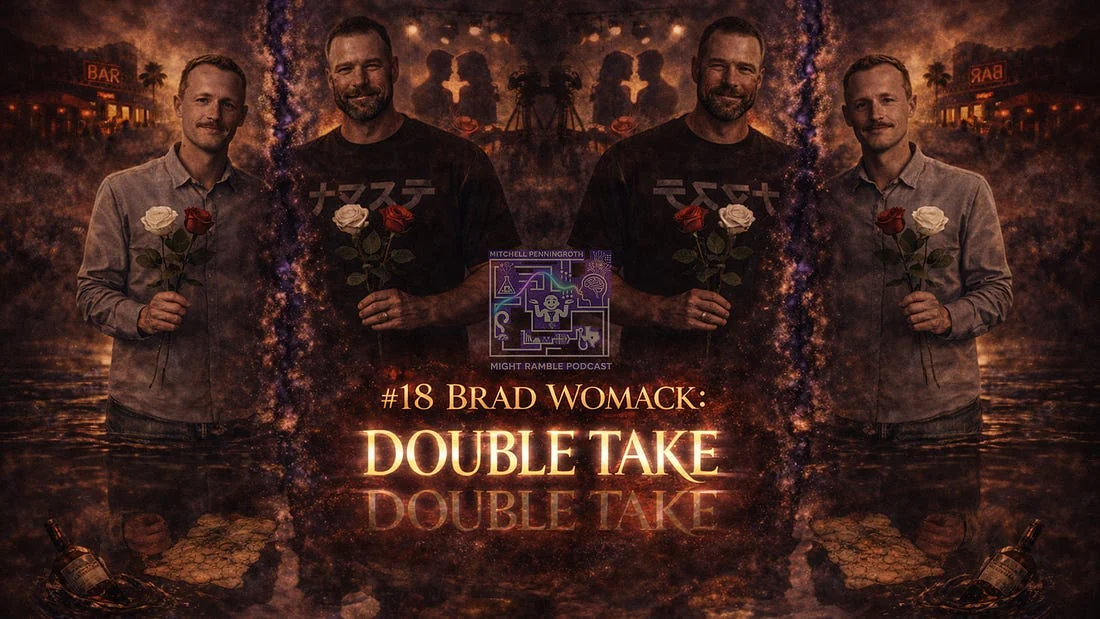
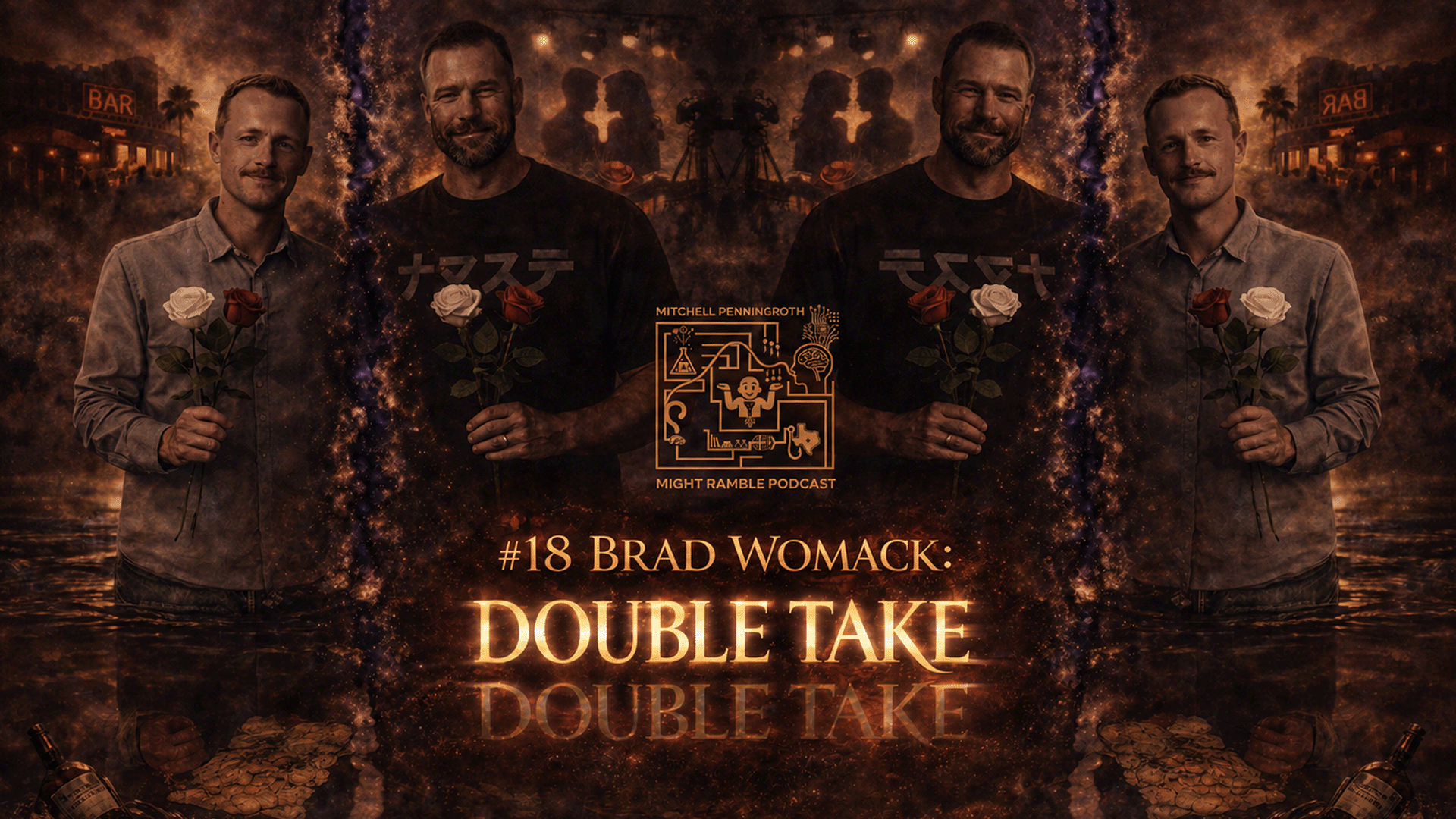
The episode artwork is built around reflections — Brad reflected over the vertical axis, two of him facing each other across the center. Same face, different person. This is the essence of being an identical twin, and it has a chemical name: chirality. Two structures that are identical but not superimposable. Put your right hand over your left and notice how your thumbs don’t align. Your hands are the same, and yet not. The reflection also represents different moments in time — which side you’re looking at determines which Brad you’re seeing.
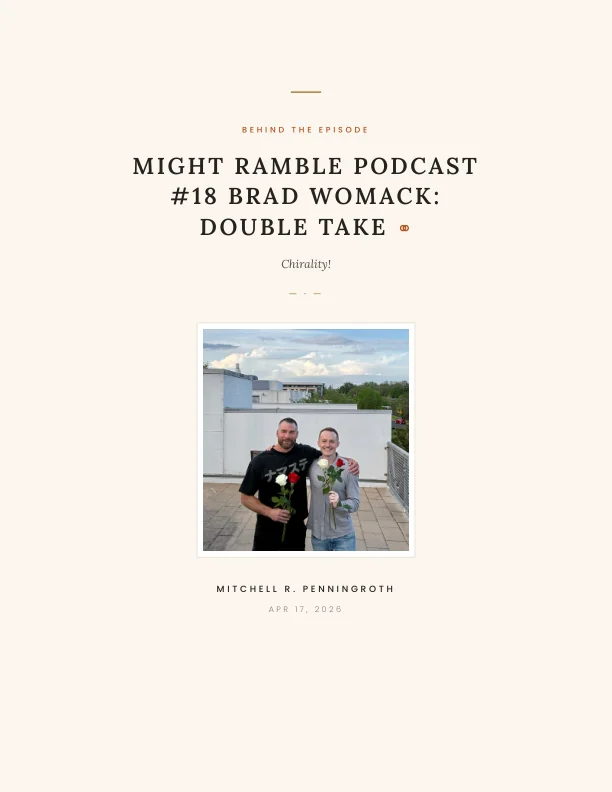
The two roses carry the same duality, along with the fact that Brad was The Bachelor twice. Red is then — the Bachelor era, the public spectacle. White is now — the harder-won version of the same man. Same but different. That’s the whole thing. It applies to me too, in its own way — I brought two roses because we’re both twins, yet we’re not our twins, and neither of us is who we were or who we were made out to be in certain contexts.
The reflection extends downward into water. The image above is sharp, the image below distorts. That’s intentional. It works on two levels simultaneously: one twin being more publicly “known” than the other, more resolved in the world’s perception — and the past and present differ in the same way, the past always softer and harder to verify what the actual reality was. Memories fade over time and become distorted.
It also represents what fame does to a person’s sense of self. The Bachelor version of Brad that millions of people think they know is a reflection of a reflection — produced, edited, and broadcast back at him until it became almost impossible to see the original underneath.
The bar signs visible on either side of the frame aren’t decoration. Brad stumbled into the most-watched franchise on television after a chance conversation at a bar. The bar business is where he started, and where he was discovered, marking the transition from normal life into the uniquely singular psychological experience of being The Bachelor. It’s the before and the after, bracketing everything in between.
The title reflects itself too. Double Take, and then Double Take again below it, dissolving into the ground. The episode is about dualities: two seasons, two twins, two small towns, two versions of the same person — one defined by others, one finding his own definition. You look once and think you understand it. Then you look again.
Thank you to my brother Keith for your last-minute help in getting things ready and for letting me turn our living space into a production studio, and to my friend Marianne Loire for your generosity in making all of this a reality.